
A five-touch reminder sequence for US dental practices, with the HIPAA and TCPA rules behind it, what each message must never contain, and a worksheet to price your empty chair.
Search and explore the blog
Explore the blog
Category
Suggested reading
- CRM & Automation
DPDP Act for Real Estate Marketing: What Builders and Brokers Must Change Before May 2027
9 min read
- CRM & Automation
Lead Management Excel Template for Real Estate Brokers, and When to Move to a CRM
9 min read
- CRM & Automation
Lead Deduplication for Real Estate: Why the Same Buyer Shows Up Again and Again in Your CRM
9 min read
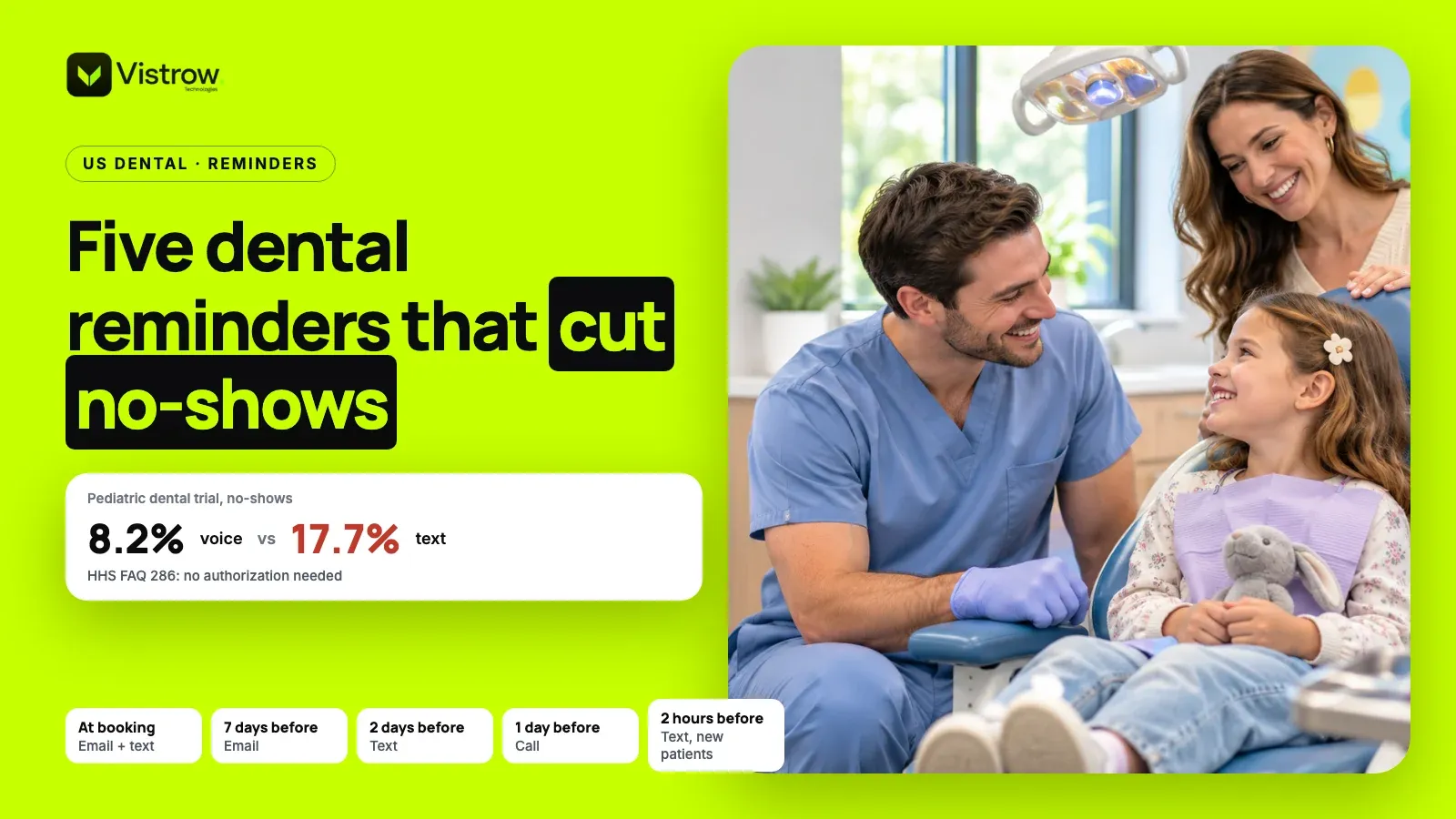
A layered sequence is the fastest way to improve dental appointment reminders: a confirmation at booking, an email a week out, a text two days before, and a call the day before for anyone still unconfirmed. HHS says reminders may go out without patient authorization, as long as the content stays minimal.
The common mistake is a single automated text, sent once, to a number nobody verified. It feels like a system. It is really one chance, and if the message is filtered by a carrier or lands on a phone the patient rarely checks, the chair sits empty and nobody knows why.
Below is the full sequence, the rules behind it, what each message must never contain, and a simple way to price what an empty chair costs your practice using your own numbers.
What are dental appointment reminders, and what do the rules allow?
Dental appointment reminders are short messages, sent by text, email or phone, that tell a patient when they are booked and ask them to confirm or reschedule. The legal side is simpler than most offices fear, but it has edges you need to respect.
On privacy, the US Department of Health and Human Services explains in HHS FAQ 286 that appointment reminders are treatment communications and may be sent without patient authorization. That does not mean anything goes. Keep the content to the practice name, the date, the time and a confirm or reschedule option. Never put the procedure or a diagnosis in a text, a voicemail or an email preview, because a phone screen can be read by anyone standing nearby.
On calls and texts, the FCC created a limited exemption under the Telephone Consumer Protection Act in its 2015 order for certain healthcare messages, appointment reminders included. The conditions matter. Send only to the number the patient gave you, identify the provider, keep the message short, include no marketing, honor opt-outs right away and limit how often you send. Break those conditions and you are outside the exemption.
One more practical point. The exemption covers the reminder, not your whole patient communication program. Each stream you add, whether recall, review requests or promotions, needs its own check against the same conditions before it goes live.
When does a reminder turn into marketing?
A message that says "see you Tuesday at 9:30" is a reminder. Add "and ask about our whitening special" and you have turned it into marketing. Marketing texts need prior express written consent, which the exemption does not cover.
The same line runs through dental recall reminders. A plain recall message that says it is time to book a cleaning is treatment related. A recall message carrying a discount or a promotion is an offer. Keep the two streams separate, with separate templates, and keep a consent record for the second kind.
The FCC has been revising its consent revocation rules, with a 2024 order, some waivers and a 2025 further notice, so a practice should check the current rule before building anything. Treat any STOP reply as an opt-out, whatever wording the patient uses, and stop immediately. None of this is legal advice, so have your counsel confirm the setup. If you want to see how a US practice might structure this, the US dental clinics page is a good starting point.
What does the evidence say about text, email and phone?
Vendors love to promise 30 to 50 percent drops in no-shows. Those figures are unverified, so this guide does not repeat them. The published evidence is thinner, and more useful.
A randomized trial in a university pediatric dental clinic found fewer no-shows with voice reminders than with texts: 8.2% against 17.7%. A single-office orthodontic study, by contrast, found no significant difference between SMS, phone and email. Different clinics, different patients, different answers.
Read together, they say the right channel depends on the patient. That is why a layered sequence beats a favorite channel. A parent who ignores texts may pick up a call, and a busy professional may never answer a call but confirm a text in seconds.
If you want to reduce dental no-shows, learn each patient's preference at intake and use more than one channel, rather than betting everything on the one your software happens to default to. And do not over-read either study. One was a pediatric university clinic and the other a single orthodontic office, so your own monthly numbers will tell you more than any headline.
The five-touch sequence, and what each message must not say
Here is a sequence that suits most general and family practices. Each touch has one job, and a final column lists what that message must not contain.
Only unconfirmed patients get the call. That keeps frequency low, which fits the conditions of the FCC exemption, and it saves your staff or an AI voice agent for the people who actually need a nudge. The two-hour text goes to new patients only, because they are the least familiar with your address and parking and the most likely to quietly drop off.
Write each template once, read it on a locked phone screen, and ask whether a stranger glancing at it could learn anything clinical. If the answer is yes, cut the line.
| When | Channel and job | Must not contain |
|---|---|---|
| At booking | Email and text confirmation with a calendar link | Procedure, diagnosis or balance due |
| 7 days before | Email with date, time and practice name | Treatment details in the subject or preview |
| 2 days before | Text: reply C to confirm, R to reschedule | Marketing offers or clinical wording |
| 1 day before, unconfirmed only | Call, live or AI voice agent | Procedure or diagnosis in any voicemail |
| 2 hours before, new patients only | Short text with address and time | Anything beyond logistics |
How to set it up in your practice, step by step
The sequence only works if the plumbing is right. Most failures come from a missing consent record or an unregistered number, not from the wording of the message.
Carriers require A2P 10DLC brand and campaign registration for business texting from ordinary local numbers, and unregistered traffic gets filtered. So a reminder you believe you sent may never have arrived. Ask your software vendor to confirm your registration, and check the FCC's guidance at fcc.gov for the latest on consent and revocation before you go live.
Then decide who owns the replies. An R reply that sits unread in an inbox is worse than no reminder at all, because the patient thinks the change is done. Route those replies to a person or an agent that can actually rebook.
- 1
Ask channel preference at intake
Record text, call or email as the patient's first choice, and note consent for texts.
- 2
Register for A2P 10DLC
Complete brand and campaign registration so carriers do not filter your messages.
- 3
Write templates
Practice name, date, time, confirm or reschedule option, and nothing clinical.
- 4
Route replies to someone who can book
R replies should reach a person or an agent that can actually move the appointment.
- 5
Fill freed slots
Keep a short-notice list of patients who want an earlier visit.
- 6
Review monthly
Pull the no-show rate from your practice software each month and adjust.
What does an empty chair cost? A worksheet for dental appointment reminders
Skip the industry averages and use your own numbers. Take your average production per visit from your practice software, then multiply it by the number of no-shows last month that were not refilled. That is what your empty chairs cost.
Then subtract the monthly cost of your reminder tools and the staff time spent on them. If the result is a number your owner would notice, a stronger sequence pays for itself. If your no-show rate is already low, spend your effort on refilling freed slots instead, because a cancelled slot that gets rebooked costs you almost nothing.
Keep the worksheet to three lines: average production per visit, unfilled no-shows last month, and monthly cost of reminders. There are no dollar figures here because yours will differ by procedure mix, payer mix and region, and an invented average would only mislead you.
Run it again each month. The point of dental appointment reminders is not a perfect sequence on day one. It is a number you can watch fall, and a clear signal when a change to wording or timing made things worse.
Where does an AI voice agent fit in the sequence?
The call touch is the hardest to staff. Your front desk is busiest at the exact moment unconfirmed patients need calling. Vistrow Voice can make confirmation and reschedule calls, answer after-hours calls, and hand off to staff when a patient needs a person. It is one option alongside a live caller or your software's own tools.
Whatever you choose, keep the escalation rule simple. Any request that needs judgment, such as pain, a billing question or a clinical concern, goes straight to a human. The agent's job is to confirm, move a time and capture the answer, not to discuss treatment.
If you want a second pair of eyes on your current sequence, quotes come after a free audit, which you can request through the growth audit page. Bring your last three months of no-show data and your current templates, and you will have something concrete to work from.
Frequently asked questions
Can a dental office send appointment reminder texts under HIPAA?
Yes. HHS FAQ 286 treats appointment reminders as treatment communications, so they can be sent without patient authorization. Keep the content minimal: practice name, date, time and a confirm or reschedule option. Never put the procedure or a diagnosis in a text, voicemail or email preview, since others may see it.
Do dental reminder texts need written consent under the TCPA?
Plain appointment reminders can fall under the FCC's limited healthcare exemption if they go only to the number the patient gave, identify the provider, stay short, carry no marketing and honor opt-outs. Marketing texts such as recall offers or promos need prior express written consent. Check current rules or ask counsel.
Which reminder channel reduces dental no-shows the most?
No single channel wins everywhere. A randomized trial in a university pediatric dental clinic found fewer no-shows with voice reminders than texts (8.2% vs 17.7%), while a single-office orthodontic study found no significant difference between SMS, phone and email. Use several channels and learn each patient's preference.
What is A2P 10DLC and do dental practices need it?
A2P 10DLC is the carrier registration system for business texting from ordinary local numbers. You register your brand and campaign, and unregistered traffic gets filtered, so reminders may never arrive. If your practice texts patients through software, confirm that registration is done for your number.
How many dental appointment reminders should a patient get?
A workable pattern is five touches: a confirmation at booking, an email a week before, a text two days before, a call the day before for unconfirmed patients, and a short text two hours before for new patients only. Keep frequency limited to stay within the TCPA conditions.
Comments