
A blurred RERA number and QR code cost an Akola developer Rs 10,000 in January 2026. Here is where the MahaRERA QR code must sit on every ad, and how to check it before you publish.
Search and explore the blog
Explore the blog
Category
Suggested reading
- Digital Marketing
Dental Marketing Agency or In-House? Where UK Practices Should Spend on Google, Social and Their Website
10 min read
- Digital Marketing
Landing Page Design Cost in India (2026): What Each Price Band Gets You
8 min read
- Digital Marketing
Fake Leads from Facebook Ads in India: Why They Happen and How to Filter Them
8 min read
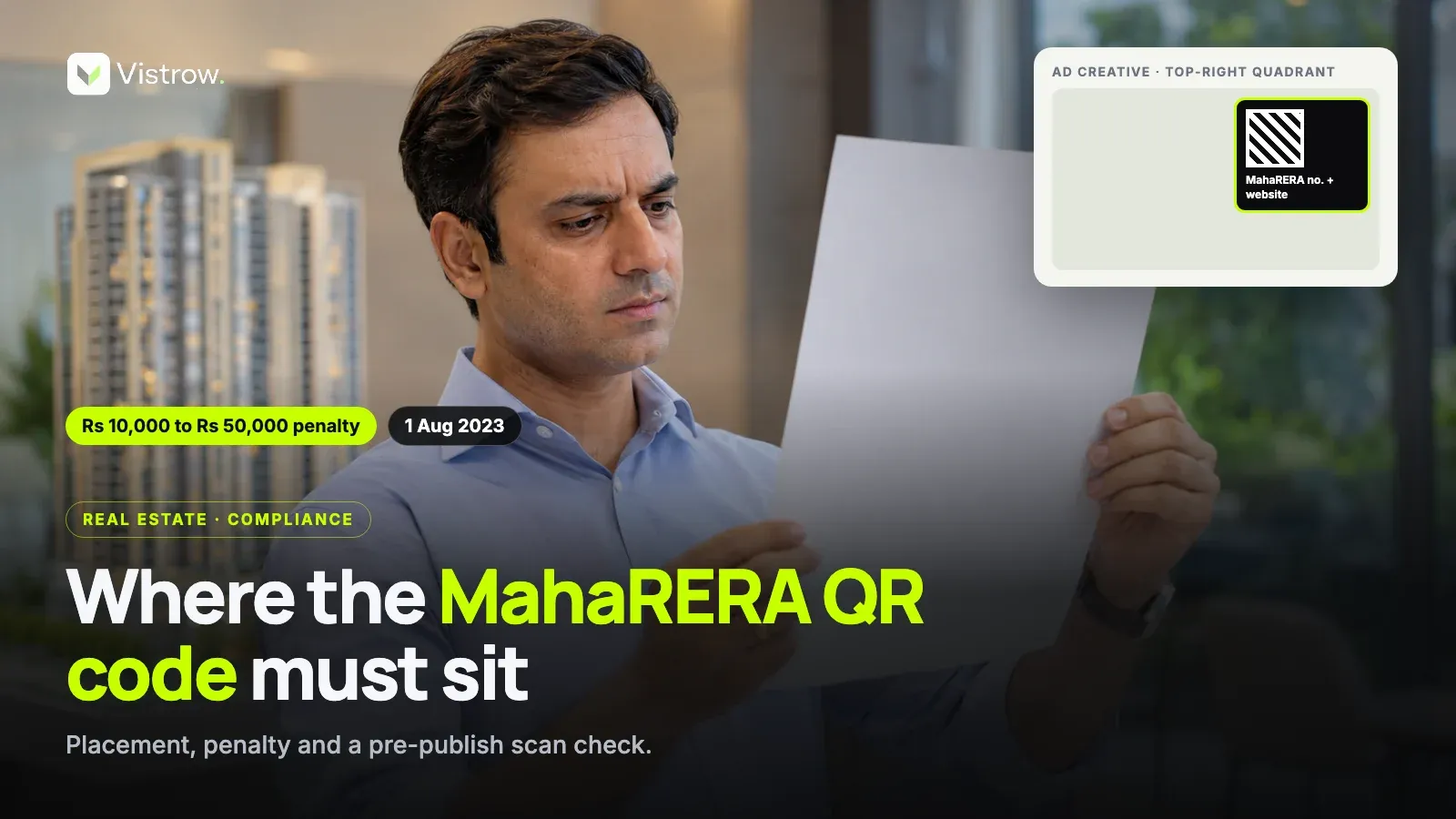
A MahaRERA QR code advertisement must carry the project's registration number, the MahaRERA website address and a scannable QR code, placed prominently in the top-right quadrant of the creative. The QR rule applies to ads published after 1 August 2023, and in January 2026 an Akola developer was fined Rs 10,000 for a newspaper ad where the number and code were blurred.
That fine is the detail worth remembering. The code was in the ad. It just could not be read. A code can be present and still fail if it gets compressed, shrunk or pushed into a corner to make room for a bigger headline. This post covers where the code has to sit on each channel, who is bound, what the penalty looks like and a checklist you can run before any ad goes live.
MahaRERA QR code advertisement rules: what changed and when
The QR requirement became mandatory for project ads published after 1 August 2023. Check the exact order and circular text on the regulator's own site at maharera.maharashtra.gov.in. Promoters and real estate agents are both bound by it.
A circular dated 8 April 2025 then tightened placement. The registration number, the MahaRERA website address and the QR code must be prominent, in the top-right quadrant of the creative, in a high-visibility colour, legible and scannable. It is reported to cover newspapers, leaflets, banners, hoardings, social media and WhatsApp, so the digital creatives your performance team produces are in scope, not only print.
No 2026 circular changing these rules turned up in a search of recent coverage, so the April 2025 circular is the one to work from for now. That can change, which is why the habit that matters is checking the current circular before each campaign rather than relying on a blog post, this one included. Nothing here is legal advice.
What counts as a project promotion, and what goes in the box?
Think of the rule as covering anything that promotes a registered project to the public. A newspaper ad, a leaflet handed out at a site, a hoarding on a highway, a Facebook creative, an Instagram carousel, a Google Ads image asset and a WhatsApp broadcast image all qualify. If a buyer could see it and be nudged towards a project, treat it as covered.
The box itself holds three things: the maharera registration number in advertisement form, the MahaRERA website address and the QR code. The number has to belong to the project being advertised. A creative for a second phase that still carries the first phase's number is an easy mistake to make, and an equally easy one to catch if somebody compares the printed number against a log.
Colour matters more than people expect. A pale grey code on a cream background can look elegant in a design review and fail completely on a phone. Use a high-contrast colour, keep a clear margin around the code and resist the urge to place it on a busy photograph.
Where the QR code must appear on each channel
The rule says top-right, but each channel has its own way of damaging a code. Platforms crop images, compress them and overlay buttons or captions on the corners. On some Meta placements the top-right is also where interface elements land, so a safe zone is not optional. Print has the opposite problem: it looks fine on screen and then a low-resolution file turns the code to mush on newsprint.
The table below lists what to check on each channel. The scan test is the one step people skip, and it is the one that would have saved the Akola developer.
Notice that the scan has to happen on the version the buyer will actually see. For WhatsApp that means the copy received on another phone, because WhatsApp compresses images. For Google Ads it means every aspect ratio you upload, because automatic cropping can clip a corner.
| Channel | Size and placement | Scan test | Number check |
|---|---|---|---|
| Facebook and Instagram creative | Top-right box clear of platform overlays in Feed and Stories | Scan the exported file and the live preview | Matches the project registration |
| Google Ads image asset | Top-right after cropping to each ratio | Scan every ratio you upload | Matches the project registration |
| Landing page | Visible near the top, not buried in the footer | Scan from the live page on a phone | Matches the project registration |
| WhatsApp broadcast image | Top-right, survives compression | Scan the received copy, not the original | Matches the project registration |
| Print and leaflets | Top-right, high-contrast colour | Scan a printed proof | Matches the project registration |
| Hoardings | Large enough to read from a distance | Scan a scaled-down proof | Matches the project registration |
What is the penalty for breaking the rule?
The penalty is reported as a minimum of Rs 10,000 and up to Rs 50,000. That range may not apply to every case, since the outcome depends on the complaint and the bench that hears it. Treat it as a guide to scale, not a quote.
The Akola case is the useful reference point. According to LiveLaw, MahaRERA's Nagpur bench fined the developer Rs 10,000 in January 2026 for a newspaper ad with a blurred RERA number and QR code. The code was present, but nobody could read or scan it. So the standard in practice is legibility and scannability, not mere presence.
The fine is also the smaller cost. Pulling and reprinting an ad, or pausing a paid campaign while you fix creatives, usually costs more. If your account runs through performance advertising, a rejected or paused creative can also mean a campaign loses days of momentum while the replacement goes through review.
Who is responsible: the builder or the agent?
Both. Promoters and real estate agents are bound by the rule, so a broker cannot say the builder supplied the creative. If you repost it in a WhatsApp group or run it as your own ad, you own the compliance for that post.
The practical fix is dull but effective. Before reposting, the agent checks that the number matches the project, that the box sits top-right and that the code scans on a phone. If any of those fail, ask the builder's marketing team for a corrected file rather than editing it yourself, because a quick crop or resize is exactly how a code gets clipped.
Developers should make this easy for channel partners. Send the approved creative as a high-resolution file, name it with the project and date, and include the registration number in the message. That one habit removes most of the guesswork on the agent's side.
How to keep rera compliant real estate ads from slipping through
Compliance is a process problem, not a design problem. If it depends on someone remembering, it will eventually fail on a busy Friday before a weekend launch. Build it into how creatives are made.
Keep one master creative template with a locked top-right box. Designers add the headline and image around it, and nobody can move or resize the box. Keep a single log of registration numbers per project, so the person exporting a file copies from one source of truth. Then make a phone scan of every export a required step, not a nice-to-have.
The MahaRERA project QR code comes from the regulator, so do not swap it for a lead-capture QR code on the same creative.
- Lock the top-right box in the master template
- Scan every export on a phone before upload
- Log the registration number per project in one place
- Re-check after any resize or crop for a new placement
- Agents verify builder-supplied creatives before reposting
A pre-publish checklist for a Meta ad
Here is a worked example for a single Meta ad. It takes about two minutes and catches the failures that lead to penalties. The key habit is to scan the file you will actually upload, not the design source, because compression and cropping happen after the designer is done.
Run the same steps for every new creative and every resize, even if the change feels tiny. A creative that passed last week can fail after someone nudges the layout for a Stories placement.
- 1
Open the exported file
Use the final PNG or JPG, not the layered design file.
- 2
Check the top-right box
Registration number, MahaRERA website and QR code sit inside it, in a high-visibility colour.
- 3
Scan with a phone
Hold the phone at normal distance and confirm the code opens the right project page.
- 4
Match the number
Compare the printed registration number to your project log.
- 5
Preview each placement
Check Feed, Stories and Reels crops so no platform element covers the box.
- 6
Save the approved file
Store it with the date so you can show exactly what ran if asked.
Why just add a QR code is not enough advice
Most guides stop at telling you to add the code, which misses the real risk. The Akola penalty was for a code that existed but was blurred, which means the real risk sits in production, resizing and compression, not in the decision to include it.
Treat the box like a fixed clause in a contract: same position, same size, tested every time. Once that is a habit, a MahaRERA QR code advertisement stops being a last-minute scramble and becomes part of how every creative is built.
If you want a second pair of eyes on your live creatives, Vistrow, an AI-powered digital marketing agency in Pune, can review them through a Growth Audit. The same pre-publish habit applies to lead forms, covered in Facebook lead form vs landing page for real estate. And whatever you do, confirm the final requirements on the MahaRERA website, since circulars can be updated.
Frequently asked questions
Is a QR code mandatory in MahaRERA advertisements?
Yes. For project promotions published after 1 August 2023, MahaRERA requires the project's QR code along with the registration number. This applies to promoters and to real estate agents who advertise the project. Always confirm against the current circular on the MahaRERA website before publishing.
Where should the QR code be placed in a real estate ad?
The 8 April 2025 circular asks for the registration number, MahaRERA website address and QR code to be prominent, in the top-right quadrant of the creative. They should be in a high-visibility colour, legible and scannable. Check the current circular for the exact wording.
What is the penalty for a missing MahaRERA QR code?
Trade coverage reports the penalty as a minimum of Rs 10,000 and up to Rs 50,000. Actual outcomes depend on the case. In January 2026, a developer in Akola was fined Rs 10,000 for a newspaper ad with a blurred RERA number and QR code.
Does the MahaRERA QR rule apply to social media and WhatsApp?
Yes. The April 2025 circular is reported to cover newspapers, leaflets, banners, hoardings, social media and WhatsApp. A Facebook creative, an Instagram post or a WhatsApp broadcast image needs the same registration number and scannable QR code as a print ad.
Do real estate agents need to follow the QR code rule too?
Yes. Promoters and real estate agents are both bound. If you repost a builder's creative, you carry the risk, so check that the registration number matches the project and that the QR code scans on a phone before you share it.
Comments