
A Rs 1,00,000 budget at Rs 250 per lead sounds like 400 leads. After fakes and a 5 percent enrolment rate it is 14 admissions. Here is the maths and the filters.
Search and explore the blog
Explore the blog
Category
Suggested reading
- Lead Generation
Real Estate Lead Generation in Pune: Channels, Rules and a Monthly Plan for Builders and Brokers
9 min read
- Lead Generation
Speed to Lead in Indian Real Estate: How Fast to Call a New Enquiry and How to Get There
8 min read
- Lead Generation
Facebook Lead Form vs Landing Page for Indian Real Estate: Which Gets Site Visits
7 min read
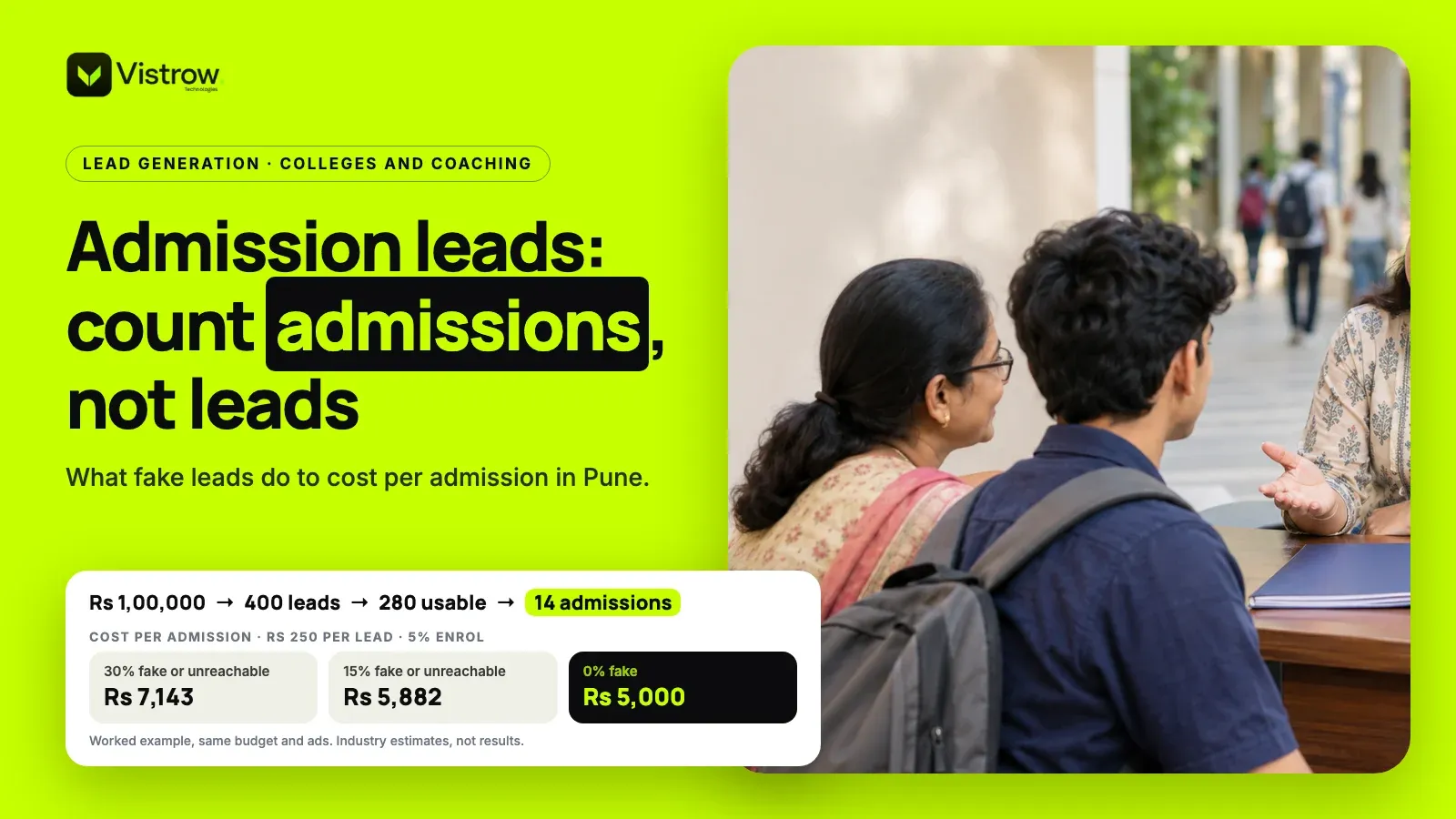
Take a Rs 1,00,000 monthly budget and a cost per lead of Rs 250. That looks like 400 leads. If 30 percent are fake or unreachable you have 280 usable ones, and at a 5 percent enrolment rate that is 14 admissions, or about Rs 7,143 each. That is admission lead generation in one paragraph: cost per lead is rarely the number that matters.
Those figures are an illustration built on industry estimates, not Vistrow client results. For colleges, junior colleges and coaching institutes in Pune, the useful question is what a lead really costs once the junk is removed, and what you can do about it before the next intake season starts.
What does admission lead generation cost, and how much of it is wasted?
Admission lead generation is the work of getting prospective students or their parents to enquire about a course, then qualifying and following up on them until they enrol. For lead generation for educational institutions, the paid part usually runs on Google Ads and Meta lead ads, with counsellors doing the calling.
Industry sources compile Indian education benchmarks that put Google Ads cost per lead at roughly Rs 300 to 800 and Meta lead ads at roughly Rs 150 to 400. These are estimates from vendor benchmark pages, not official data, and they swing with course, season and city. Lead to enrolment is often quoted at 3 to 8 percent, again an estimate. One coaching marketing guide quotes a cost per admission of Rs 8,000 to 25,000 in Tier 1 cities, also an estimate.
Notice the gap. A cheap Meta lead looks great on the report, but if a third of those numbers are wrong or never pick up, your real cost per admission climbs quietly. A common mistake is to compare channels on cost per lead alone, which rewards whichever channel produces the most junk.
Treat every number in the table below as a range to test against, not a promise. Your own account will tell you more after one month of clean tracking than any benchmark page will.
| Metric | Estimated range | Source type |
|---|---|---|
| Google Ads cost per lead | Rs 300 to 800 | Vendor benchmark pages |
| Meta lead ads cost per lead | Rs 150 to 400 | Vendor benchmark pages |
| Lead to enrolment | 3 to 8 percent | Commonly quoted estimate |
| Cost per admission, Tier 1 cities | Rs 8,000 to 25,000 | Coaching marketing guide |
How fake leads change your cost per admission
Here is the worked example again, with the fake share changing. Budget Rs 1,00,000, cost per lead Rs 250, so 400 leads, and a 5 percent enrolment rate on usable leads. The only thing that moves is how many leads are fake or unreachable.
At 30 percent fake, 280 are usable and you get 14 admissions at about Rs 7,143 each. At 15 percent fake, 340 are usable, which gives 17 admissions at about Rs 5,882. At zero fake, 400 usable leads give 20 admissions at Rs 5,000. Same budget, same ad, same counsellors.
So cutting junk is worth real money before you touch the creative. It also means a filter that raises cost per lead slightly can still lower cost per admission. If verification adds friction and your CPL rises from Rs 250 to Rs 300, Rs 1,00,000 buys about 333 leads. With 10 percent fake that is 300 usable and 15 admissions, about Rs 6,667 each, still better than the 30 percent case.
The reverse is also true. A very cheap lead source with a high fake share can look like a bargain on the dashboard and turn out to be the most expensive channel you run. That is why the target should be set on admissions.
| Fake or unreachable share | Usable leads | Admissions | Cost per admission |
|---|---|---|---|
| 30 percent | 280 | 14 | About Rs 7,143 |
| 15 percent | 340 | 17 | About Rs 5,882 |
| 0 percent | 400 | 20 | Rs 5,000 |
Fake-lead filters that work before you spend more
No filter removes all fake leads, and anyone promising that is selling something. What you can do is stack several small barriers so casual or false submissions drop out and real ones get reached quickly. Start on Meta with the higher intent form, which adds a review screen before submit, so a tap is not enough to send details.
Then add a qualifying question that a genuine student or parent can answer in seconds: course, year of passing and city. A person who typed random digits will often skip it or pick nonsense, and that tells you something. Add OTP or WhatsApp verification so the number is real and reachable. Meta documents its lead ad formats on its business help centre, which is worth reading before you edit the form.
Next, look at placements. Exclude the ones that drive junk once your data shows which they are. Then call within minutes, because a fast call both confirms the lead is real and catches interest while it is warm. Duplicates should be flagged in the CRM so the same enquiry is not counted, or called, twice.
Each filter costs a little friction, so add them one at a time and watch both cost per lead and usable share. Keep the ones that lower cost per admission.
- Meta higher intent form with the review screen
- Qualifying question: course, year of passing, city
- OTP or WhatsApp verification of the number
- Exclude placements that drive junk leads
- Call within minutes of the enquiry
- Flag duplicates in the CRM
- Track the source of every lead through to admission
Which channel suits which course?
Do not run one budget across everything. A student searching for a specific entrance exam coaching batch on Google is telling you what they want, so search tends to suit courses with clear intent, usually at a higher cost per lead. Meta suits discovery, such as a new batch, a scholarship test or a junior college intake, and usually gives a lower cost per lead with more noise.
Run each course as its own small test. Give Google and Meta a fair share of the budget, then compare cost per admission after a full counselling cycle, not after three days. Season matters too. Results and admission windows change the numbers, which is why every benchmark here is an estimate.
Local intent matters in Pune. Parents often shortlist institutes by distance, so a city or locality question in the form is useful both as a filter and as a way to route the lead to the right branch.
What do the CCPA rules mean for your admission ads?
Your ad copy has a legal layer now. The CCPA issued Guidelines for Prevention of Misleading Advertisement in Coaching Sector on 13 Nov 2024 under the Consumer Protection Act 2019, and a summary from Cyril Amarchand Mangaldas covers how they apply to schools and coaching centres.
In plain terms, you cannot make unverified claims of 100% selection, guaranteed admission, ranks or jobs. Topper photos need written consent and course details alongside them. That affects the most common coaching ad format, the wall of toppers with a big percentage.
Write ads around what you can prove: faculty, batch size, test series, timings, fee structure. This is a summary for marketers, not legal advice, so have the final copy checked against the guidelines themselves. A compliant ad often attracts fewer but better-informed enquiries, which helps cost per admission anyway.
How does the DPDP Act affect student leads in India?
Student leads are personal data, and many are minors. Under the DPDP Act and Rules 2025, notified in November 2025, data of students under 18 needs verifiable parental consent. Rule 10 phases in later, and tracker sites say May 2027, so verify the date against the official text on the Ministry of Electronics and IT website before you plan around it.
Practically, your forms should say who you are, why you want the details and how you will contact them. For junior college and coaching leads, think about how a parent confirms consent, perhaps through the same WhatsApp or OTP step you already use for verification. Verification then does double duty.
Keep records of when and how consent was given. Again, this is not legal advice, so get a lawyer to review your process.
Six steps from budget to admissions
The order matters more than the tools. Many institutes start with the ad and discover the maths later, when the month is spent. Reverse it: decide what an admission is worth to you, then build the funnel backwards.
Follow-up is where a good share of the value is won or lost. A lead that gets a call within minutes and a WhatsApp message with fees, batch timing and a demo class link is far more likely to stay engaged than one that waits until tomorrow.
- 1
Set a cost per admission target
Work back from course fee and margin, not from what a lead costs.
- 2
Choose channels by course
Search intent suits some courses, Meta suits others, so test each against admissions.
- 3
Write compliant ads
Avoid guarantees and unverified results, and get written consent for topper photos.
- 4
Verify leads
Qualifying question, OTP or WhatsApp check, duplicate flag.
- 5
Follow up on WhatsApp and phone
Call within minutes, then continue on WhatsApp with fees, batch timing and a demo class.
- 6
Measure admissions per source
Judge every channel on enrolments, not enquiries.
How to track admissions per source
This is where most reporting falls apart. Leads sit in a Meta export, calls happen from a personal phone and enrolments are in a register. Nobody can say which campaign produced which admission, so budget decisions become guesses.
A CRM for coaching institutes fixes this if each lead carries its source, a stage and a call outcome. Then you can see admission lead generation by channel: cost per lead, usable share, enrolment rate and finally cost per admission. Tools built for real estate such as ArthaLeads show the pattern, with AI lead scoring from 0 to 100, duplicate flags and a pipeline, though your stages would be enquiry, counselled, demo attended and enrolled.
Once you have source to admission data, shift budget slowly toward whichever source gives the lowest cost per admission. Do it in small steps, because one strong week is not a trend. For more on how this works for schools, colleges and coaching, see our education industry page.
Frequently asked questions
What is the cost per lead for admissions in India?
Industry benchmark pages put Google Ads cost per lead for education at roughly Rs 300 to 800 and Meta lead ads at roughly Rs 150 to 400. These are vendor estimates, not official data, and they vary by course, city and season. Treat them as a starting range and track your own.
What is a good cost per admission for a coaching institute?
One coaching marketing guide quotes Rs 8,000 to 25,000 per admission in Tier 1 cities, which is an estimate. A good number is one your fee margin can carry. Work backwards from fee, then set a cost per admission target before choosing channels.
How many leads turn into admissions?
Lead to enrolment is often quoted at 3 to 8 percent in industry sources, which is an estimate. Your rate depends on course, fee, follow-up speed and lead quality. Measure it per source so you know which channel actually produces admissions.
How do I stop fake leads from Meta lead ads?
Use the higher intent form with a review screen, add a qualifying question such as course, year of passing and city, verify by OTP or WhatsApp, and call within minutes. Flag duplicates in your CRM. No filter removes all fake leads, so keep measuring.
Do I need parental consent for student leads in India?
Under the DPDP Act and Rules 2025, notified in November 2025, data of students under 18 needs verifiable parental consent. Some provisions phase in later, and tracker sites mention May 2027 for Rule 10, so verify the dates. This is not legal advice, so check with a lawyer.
Can coaching ads promise 100% selection?
No. The CCPA Guidelines for Prevention of Misleading Advertisement in Coaching Sector, issued 13 Nov 2024, bar unverified claims of 100% selection, guaranteed admission, ranks or jobs. Topper photos need written consent and course details. This is a summary, not legal advice.
Comments