
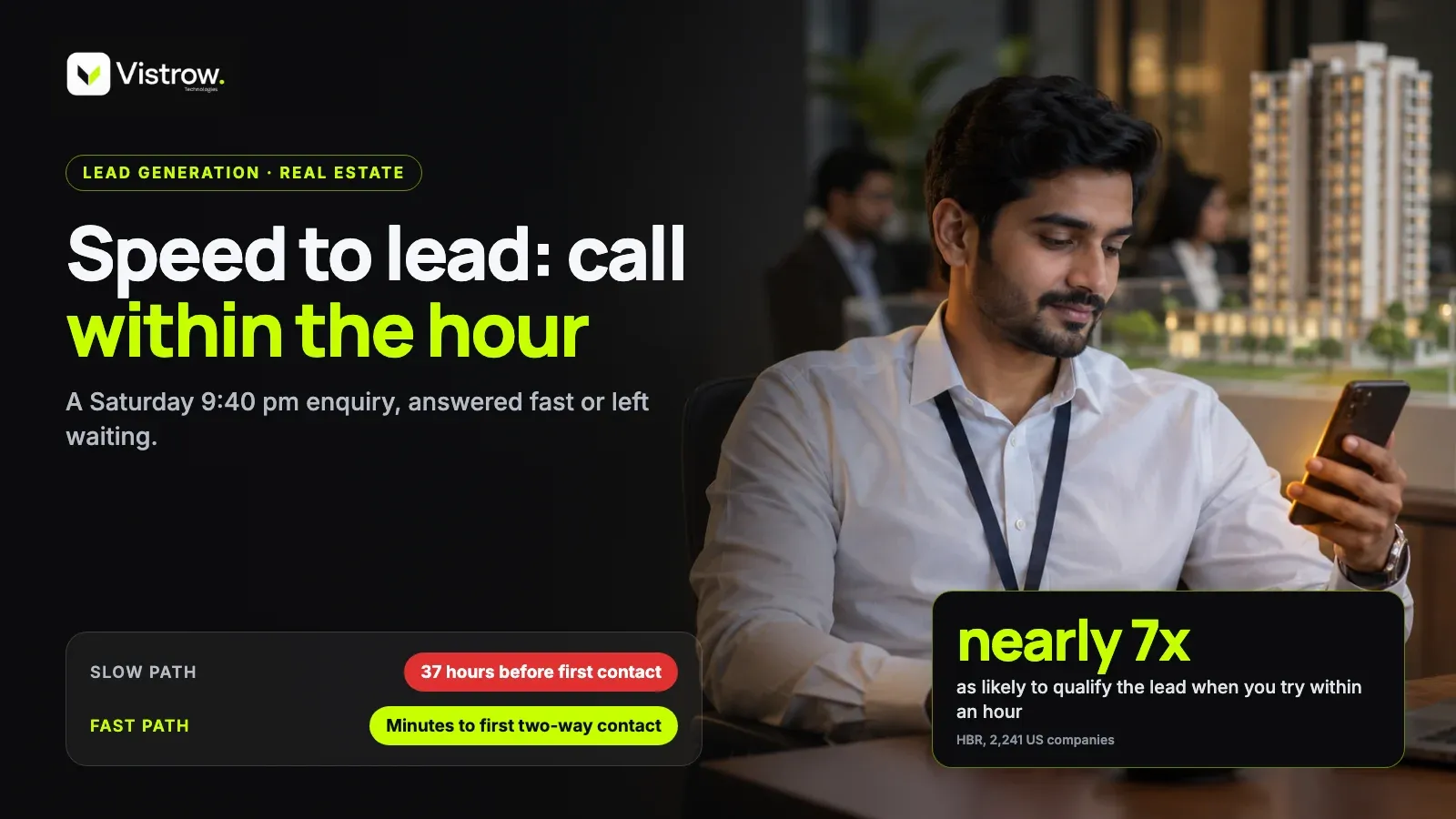
A Saturday 9:40 pm Facebook lead called back on Monday has waited about 37 hours. Here is what the research says about response time and how to fix it.
Search and explore the blog
Explore the blog
Category
Suggested reading
- Lead Generation
Admission Lead Generation in Pune: Cost per Lead and Fake-Lead Filters for Colleges and Coaching Institutes
9 min read
- Lead Generation
Real Estate Lead Generation in Pune: Channels, Rules and a Monthly Plan for Builders and Brokers
9 min read
- Lead Generation
Facebook Lead Form vs Landing Page for Indian Real Estate: Which Gets Site Visits
7 min read
Call a new real estate enquiry within minutes, and treat one hour as the outer limit. HBR found that firms trying within an hour were nearly 7x as likely to qualify a lead. A Facebook lead that arrives on Saturday at 9:40 pm and is called on Monday at 11 am has waited about 37 hours.
That gap is where most developers and brokers lose buyers. The ad works, the form fills, and then the enquiry sits in a sheet over the weekend while the buyer talks to three other projects. Speed to lead is the one part of the funnel you can improve without spending another rupee on ads.
One caution before the numbers. The research below is American. No public Indian dataset exists on response time in real estate, so treat it as direction, then measure your own.
What is speed to lead and how do you measure it?
Speed to lead is the time from a buyer's enquiry to your first two-way contact with them. Two-way is the important part. A call that connects, or a WhatsApp reply that the buyer answers, counts. An auto-SMS saying "thanks, we will get back to you" does not, because nothing has been exchanged yet.
Measuring it is simple if every lead lands in one CRM with a timestamp. Take the time the lead was created, take the time of the first real contact logged against it, and look at the median across a month. Use the median rather than the average, because a single lead forgotten for a week will distort an average badly.
Most teams have never done this. They have a feeling that they are fast, and that feeling is built on the leads they remember, which are usually the ones handled well. The forgotten ones do not show up in memory, only in the timestamps.
What does the HBR research say about response time?
The most quoted source is the Harvard Business Review article The Short Life of Online Sales Leads by Oldroyd, McElheran and Elkington (2011). They sent a test web lead to 2,241 US companies. About 37% replied within an hour, 16% took 1 to 24 hours, 24% took longer than a day, and 23% never replied at all. Among those that replied within 30 days, the average wait was 42 hours.
The finding that matters most is this: firms that tried to contact the lead within an hour were nearly 7x as likely to qualify it as firms that took longer. Nearly one in four never answered at all, which tells you the bar for being fast is lower than it looks.
You will also see "5 minutes means 100x the contact odds and 21x the qualification odds" repeated online. That comes from the 2007 Lead Response Management study, a US study run by Oldroyd with InsideSales.com. It is older and from a different market, so quote it as US, 2007, and not as a rule for Pune or Hyderabad.
Be honest about the gap. No public Indian dataset shows how response time changes contact rates or site visit rates in real estate. Anyone quoting an Indian percentage is guessing. The research gives direction. Your own CRM timestamps give the answer for your projects.
Where does response time break down in Indian real estate?
Delay is rarely about effort. It comes from structure: nobody owns the lead, it arrives at night, it arrives on a weekend, or it arrives somewhere nobody is looking. Portal enquiries from 99acres, Housing.com and MagicBricks often sit in an email inbox until someone exports them.
The table below maps each response bucket to what usually causes it. It is a diagnostic, not a set of rates, because there are no public Indian figures to fill it with. Use it to ask which row your own leads fall into most often.
If most of your slow leads sit in the last two rows, the fix is not a faster telecaller. It is ownership, routing and after-hours cover. A person who calls in two minutes still cannot help a lead that nobody has seen yet.
| Time to first contact | What usually causes it |
|---|---|
| Under 5 minutes | Lead is routed instantly and someone, or an AI agent, is watching |
| 5 to 60 minutes | Owner exists but is on another call or at a site visit |
| 1 to 24 hours | No owner assigned, or the lead arrived after hours |
| Over 24 hours | Weekend leads, portal leads sitting in email, or leads waiting on a sheet import |
A Saturday 9:40 pm lead on the slow path and the fast path
Take one Facebook lead ad enquiry at 9:40 pm on Saturday. On the slow path it lands in a Google Sheet. Nobody opens it on Sunday. On Monday at 11 am a telecaller starts the day, finds the row and calls. That is about 37 hours, and the buyer may not pick up an unknown number now that the ad is a distant memory.
On the fast path the lead imports into the CRM instantly. A WhatsApp AI agent replies within moments, asks the buyer's budget and timeline, and offers a site-visit slot. The buyer answers on Saturday night, in their own time. At 10 am on Monday the telecaller calls, with the budget, timeline and preferred slot already saved on the lead.
Notice what changed. The telecaller did not get faster. The first conversation simply stopped depending on the telecaller being awake. The Monday call is also warmer, because it starts from what the buyer said instead of a cold script, and the buyer already has a slot to say yes to.
How do you improve speed to lead in seven steps?
Fixing response time is mostly plumbing and ownership, not heroics. Here is the order we recommend, using ArthaLeads as the example. The same logic applies to any CRM that timestamps contacts.
Start with measurement, because without a baseline you cannot tell whether anything improved. Then remove the places where leads wait unseen, and only then think about scripts and incentives.
- 1
Measure your median first-response time
Use CRM timestamps for lead created and first contact, over the last month.
- 2
Route every source into one CRM
Meta lead ads, WhatsApp chats and website forms import automatically in ArthaLeads. 99acres, Housing.com and MagicBricks leads come from a sheet, so fix an import schedule.
- 3
Assign an owner to each lead
A lead with no named person is the lead that waits longest.
- 4
Cover nights and weekends
Use the ArthaLeads WhatsApp AI agent (Growth plan) or Vistrow Voice to make first contact when the team is off.
- 5
Flag duplicates before calling
ArthaLeads flags a likely duplicate before anyone calls, so a buyer who arrives from two sources gets one call.
- 6
Call high AI scores first
ArthaLeads gives every lead an AI score from 0 to 100, so the best leads get the earliest calls.
- 7
Review first-response time weekly
Look at the median and the slowest ten leads, and ask why each one waited.
Why the import schedule and duplicate check matter more than people expect
Portal leads are the awkward case. ArthaLeads does not sync live with 99acres, Housing.com or MagicBricks. Leads from those portals are added or imported from a sheet. So the honest fix is a fixed schedule, for example a named person importing at set times each day, rather than hoping someone remembers. A portal lead waiting for the next import has a built-in delay, so shorten that window as far as you can.
Duplicates are the quiet cost. If one buyer enquires through a Facebook ad and a portal, two telecallers may call within minutes of each other. That looks like speed and plays like chaos, and the buyer remembers it. Read more in lead deduplication for real estate, and check for duplicates before the first dial.
Priority matters here too. When ten leads arrive together, the AI score tells the telecaller who to ring first. The highest scores go to the front of the queue, and the rest follow within the hour.
How fast should you call, and what should you not promise?
Our recommendation: aim for first two-way contact within minutes during working hours, treat one hour as the outer limit, and use automation so that nights and weekends never become 37-hour gaps. That follows the direction of the HBR and 2007 US findings without pretending they are Indian numbers. Strong speed to lead is a habit your system enforces, not a target you hope people hit.
Do not expect fast response alone to rescue a weak project, a wrong audience or a poor script. A fast call that opens badly still loses the buyer, only sooner. Also be careful about the rules for outbound calling, especially automated calls, so read whether cold calling is illegal in India before you scale any voice campaign. If you use WhatsApp for first contact, the WhatsApp Business Platform documentation explains how official messaging works.
Write down this month's median, pick a target, and look again in four weeks. If the number has not moved, the cause is almost always ownership or routing, not effort. For help setting up the follow-up flow end to end, see our lead follow-up systems page, and treat speed to lead as a number someone on your team owns by name.
Frequently asked questions
What is speed to lead?
Speed to lead is the time between a buyer sending an enquiry and your team making first two-way contact with them. A call that connects or a WhatsApp reply the buyer answers counts. An automatic SMS or acknowledgement does not, because nobody has actually spoken to the buyer yet.
How fast should you call a new real estate enquiry?
Aim for minutes, and treat one hour as the outer limit. HBR found firms trying within an hour were nearly 7x as likely to qualify the lead. A 2007 US study put the sharpest gains at 5 minutes. There is no Indian benchmark, so track your own.
What do speed to lead statistics actually say?
In the HBR study of 2,241 US companies, 37% replied within an hour, 16% within 1 to 24 hours, 24% after 24 hours and 23% never replied. The average was 42 hours for those replying within 30 days. The 5-minute figures come from a separate 2007 US study.
Is there Indian data on response time in real estate?
No public Indian dataset exists on how response time affects contact or site visit rates in real estate. The research quoted everywhere is American. Use it as direction, then measure your own first-response times from CRM timestamps and compare them with your visit rates.
How can a small real estate team cover nights and weekends?
Use automation for the first reply and people for the next step. A WhatsApp AI agent can answer, ask budget and timeline, and offer a site-visit slot at any hour. A telecaller then calls the next morning with those answers already saved on the lead.
Comments