
Cold calling isn't banned in India, but promotional calls face strict TRAI rules on 140 numbers, DND and consent. Here is what that means for AI voice agents and your lead follow-up.
Search and explore the blog
Explore the blog
Category
Suggested reading
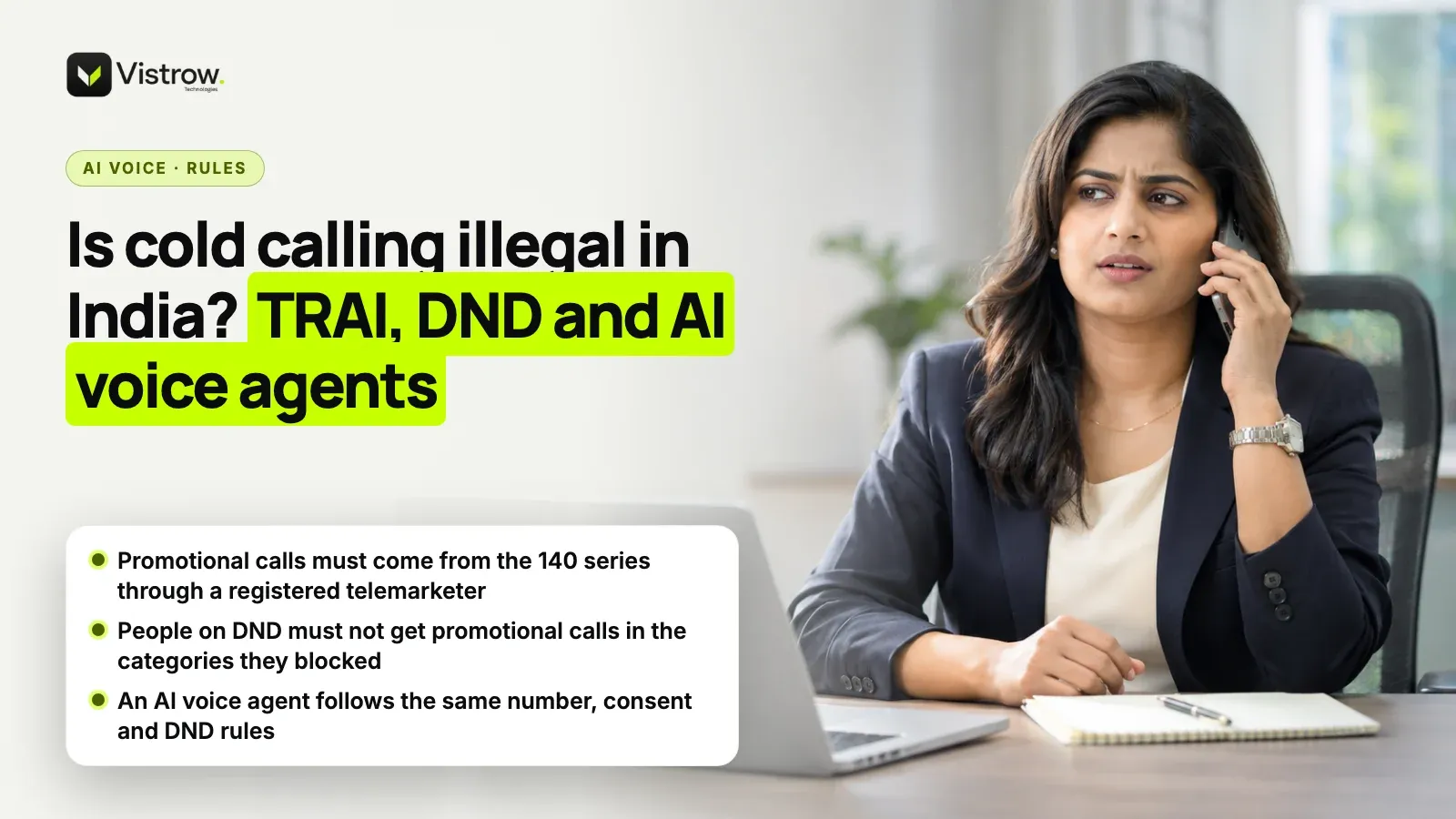
Is cold calling illegal in India? No, but promotional calls are tightly regulated. Under TRAI's TCCCPR rules, amended in February 2025, promotional calls must come from the 140 number series through a registered telemarketer, and people on the DND register must not get calls in the categories they blocked. AI voice agents follow exactly the same rules as human callers.
Founders often ask some version of this: we bought a database, so can our AI agent just start dialling it? The short answer is that the law cares far less about whether a human or an AI is speaking, and far more about which number the call comes from, who is being called and whether they agreed. Teams often spend weeks tuning an agent's voice and script and almost no time on those three questions.
The rules got sharper with TRAI's February 2025 amendment. This post walks through what applies to AI voice agents, where the real risk sits, and why calling people who already enquired is both more effective and safer. It is not legal advice, so check TRAI's current regulations or speak to a lawyer before you launch anything.
Is cold calling illegal in India, or just regulated?
Cold calling is not banned. What is regulated is commercial communication, under TRAI's Telecom Commercial Communications Customer Preference Regulations (TCCCPR, 2018), amended in February 2025. The regulator publishes its framework at TRAI, and it is worth reading the current version rather than trusting a summary, including ours.
The practical effect is that you cannot treat a purchased list as open territory. Promotional calls have to come from the dedicated 140 number series through a registered telemarketer. Transactional and service calls from regulated entities such as banks and insurers use the 1600 series. If you are neither, the safest assumption is that your marketing calls belong on 140.
Then there is the penalty for ignoring this. Using ordinary 10-digit mobile numbers for promotional calls can lead to disconnection and blacklisting of the sender's telecom resources, reported at up to two years. Teams tend to hear that as a fine they could absorb. It is not a fine. It is your outbound calling going dark for a long stretch, usually right when a campaign was working.
What did DND and the 2025 amendment change?
People who register on DND, formally the National Customer Preference Register, must not receive promotional calls in the categories they blocked. Registration happens through 1909 or the TRAI DND app, and TRAI explains the process on its unsolicited commercial communication page. It does not matter how polite your agent sounds or how relevant your offer is. A blocked category is a blocked category.
The February 2025 amendment tightened enforcement in ways that matter to senders. It lowered the complaint threshold and shortened the timelines for action. It also introduced graded financial disincentives on access providers, reported as Rs 2 lakh, Rs 5 lakh and Rs 10 lakh for repeat violations. Because the money lands on telecom providers, they now have a strong reason to act quickly against any number that attracts complaints.
There is also a draft third amendment that proposes stopping call-ID apps from blanket-tagging 140 and 1600 series calls as spam. It is still a draft, so it should not shape your plans yet. We mention it only because it shows the direction: more attention on legitimate senders being identified properly, and less patience for everyone else.
- Promotional calls: 140 series, via a registered telemarketer
- Transactional and service calls from regulated entities: 1600 series
- DND registrations: honour the categories people have blocked
- Repeat violations: graded disincentives on access providers, reported as Rs 2 lakh, Rs 5 lakh and Rs 10 lakh
Do TRAI rules apply to AI voice agents?
Here is the part many vendors blur. An AI voice agent is treated like any other caller. The same number series, consent and DND rules apply. There is no AI exemption, and there is no AI-specific loophole either. If a human telecaller could not lawfully make that call, your agent cannot make it, however cheap the minutes are.
That is why searches around ai cold calling in india so often lead to unrealistic promises. A model that speaks Hindi, English and Hinglish fluently does not change which number it dials from. Anyone telling you their technology makes the rules irrelevant is handing you a risk and calling it a feature.
We should be clear about our own lane. Vistrow Voice does not handle 140-series registration, and we do not offer legal compliance guarantees. Registering with a telemarketer, and being sure of your call purpose and consent, remain your responsibility. What the product does is make the lawful use cases fast and observable, with call history, transcripts and escalation rules you can actually audit.
Why is calling people who enquired lower risk?
Calling someone back after they filled in your form or messaged you is a service or transactional context with consent. They asked to hear from you, and that is a very different position from dialling a stranger off a list. It is also where the commercial case is strongest, because an enquiry that gets a call within minutes is far more likely to turn into a conversation than one left waiting.
This is where an AI agent earns its place. Vistrow Voice is used for calling people who enquired, plus reminders, with human handoff when the conversation needs a person. Inbound handling, outbound reminder campaigns and controlled escalation rules cover most of what a business really needs. The agent answers in the person's language, qualifies them, and either books the next step or routes the call.
Our view is that the compliance conversation and the performance conversation point the same way. If your team polishes cold campaigns while enquiries wait hours for a callback, the priorities are backwards. That is the reasoning behind our lead follow-up systems work: respond fast to people who raised their hand first, and treat cold outreach as a separate, regulated decision.
Keeping DPDP-ready consent records
The Digital Personal Data Protection Rules 2025 were notified in November 2025 and phase in through about May 2027. They require clear notice and consent for processing personal data, and an easy way for people to withdraw that consent. For calling, that means you should be able to show where a number came from and what the person agreed to when they gave it.
The simplest habit is to keep consent records from lead forms. Store the form, the timestamp, the wording the person saw and the source against each lead. When someone withdraws consent, that change should reach your calling list quickly, instead of sitting in an inbox that nobody checks.
This is where a tidy CRM matters more than a clever agent. Vistrow Voice can push leads, outcomes and transcripts downstream through CRM webhooks, so call history lives next to the consent record. If your records are scattered across spreadsheets and inboxes, fixing that through proper CRM and lead management is the first job, before any calling flow goes live.
Do and don't: a practical table for AI calling
Rules are easier to follow when they sit in one place. The table below translates the points above into daily practice for teams using an AI agent. Treat it as a starting checklist rather than a legal opinion, and have a lawyer review anything involving promotional outreach.
One pattern shows up across the rows. The safe column is almost always about starting from a real enquiry, keeping a record of consent and giving the person an easy exit. The risky column is almost always about shortcuts that look cheap on a spreadsheet.
| Do | Don't |
|---|---|
| Use the 140 series via a registered telemarketer for promotional calls | Use ordinary 10-digit mobile numbers for promotion |
| Call people who enquired through your form or message | Dial a bought list because an AI agent makes it cheap |
| Check DND status before any promotional call | Ignore the categories a person has blocked |
| Keep consent records from every lead form | Process personal data without clear notice and consent |
| Offer a human handoff and an easy way to opt out | Assume AI callers follow different rules |
| Check TRAI's current regulations or ask a lawyer | Treat a blog post, including this one, as legal advice |
A safer way to set up an AI calling flow
If you are starting from scratch, build around enquiries first and widen the scope only when the basics hold. The sequence below is the one we would follow, and it works whether you use our product or someone else's.
- 1
Capture consent at the form
Add clear notice and a consent line to every lead form, and store it with the lead.
- 2
Separate enquiries from lists
Tag each contact as enquired or purchased so the two never share a campaign.
- 3
Call enquiries fast
Use an agent for the first callback, qualification and booking the next step.
- 4
Set escalation rules
Define when the agent hands off to a person, books a visit or ends the call.
- 5
Review transcripts and opt-outs
Read call history regularly and honour withdrawals immediately.
- 6
Get promotional calling checked
If you plan any promotional outreach, confirm number series and consent with a lawyer first.
Frequently asked questions
Can an AI agent make promotional calls in India?
Only under the same rules as any other caller. Promotional calls need the 140 number series through a registered telemarketer, a check against DND preferences and a record of consent. There is no exemption for AI and no AI loophole either. The technology changes what calling costs, not your legal obligations, so plan compliance before you plan scripts.
What is the penalty for promotional calls from a normal mobile number?
Using ordinary 10-digit numbers for promotional calls can lead to disconnection and blacklisting of the sender's telecom resources, reported at up to two years. The February 2025 amendment also put graded financial disincentives on access providers, reported as Rs 2 lakh, Rs 5 lakh and Rs 10 lakh for repeat violations, so telecom providers act quickly on complaints.
Do the same rules apply to reminders and follow-up calls?
Reminders and follow-ups to people who already enquired sit in a service context, which is very different from dialling a purchased list. The category of the call and your consent records still matter, so store where each number came from. If you are unsure how a specific call should be classified, ask a lawyer rather than guessing.
Is it legal to call a purchased database in India?
Cold calling a bought list is not banned outright, but calling it for promotion from ordinary mobile numbers is the exact pattern that gets numbers disconnected. You would need the 140 series, a registered telemarketer, DND checks and consent. For most small businesses, calling people who enquired through their own forms is safer and converts better.
What do the DPDP Rules mean for calling leads?
The Digital Personal Data Protection Rules 2025, notified in November 2025 and phasing in through about May 2027, require clear notice, consent and an easy way to withdraw it. For calling, keep the form, timestamp, wording and source against each lead, and make sure a withdrawal reaches your calling list quickly instead of sitting in an inbox.
Comments