
List prices for an AI receptionist run from $49 to $500 a month, but vendors count minutes, calls or customers. Here is what it does, what it costs and who it fits.
Search and explore the blog
Explore the blog
Category
Suggested reading
An AI receptionist is software that answers your business phone with a synthetic voice, takes messages, answers scripted FAQs, books or routes callers, and sends you a summary. List prices run from $49 a month to $500, and it fits owner-run shops with simple, repeated calls better than anyone selling complex jobs.
Here is the number that shows why the price is harder to read than it looks. On Smith.ai's Pro plan you get 75 calls for $150 a month, then $2.50 for each extra call. Take 100 calls in a month: $150 plus 25 x $2.50 gives $212.50. Another vendor would count minutes, another unique customers.
So this post covers what the service does, what it costs once you convert vendor units into your own call volume, what rules apply, and which US small businesses it suits. It is a general explainer, so it does not go deep on any single trade or compare every vendor.
What does an AI receptionist actually do?
Think of an AI receptionist as a front desk that never goes home. A caller rings your number, hears a synthetic voice, says why they are calling, and the system responds from the script and information you gave it. When it cannot help, it takes a message or passes the call to a person.
It sits between two older options. A human receptionist is one person on one shift. A traditional answering service, sometimes called a virtual receptionist, uses human agents who answer for many businesses, usually billed per minute or per call. The AI version replaces the human agent with software, which is why plans are priced so differently.
You will also see it called an AI phone receptionist or an AI answering service. The labels vary by vendor, but the job is the same: pick up, listen, respond from a script, and report back. What matters is how well it handles your particular callers, not what the product page calls it.
- Answers calls 24/7, including nights, weekends and while your hands are busy
- Takes a message with the caller's name, number and reason for calling
- Answers common questions from a script, such as hours, address and services
- Books an appointment or routes the call to the right person
- Sends you a summary after each call
How much does an AI receptionist cost in the US?
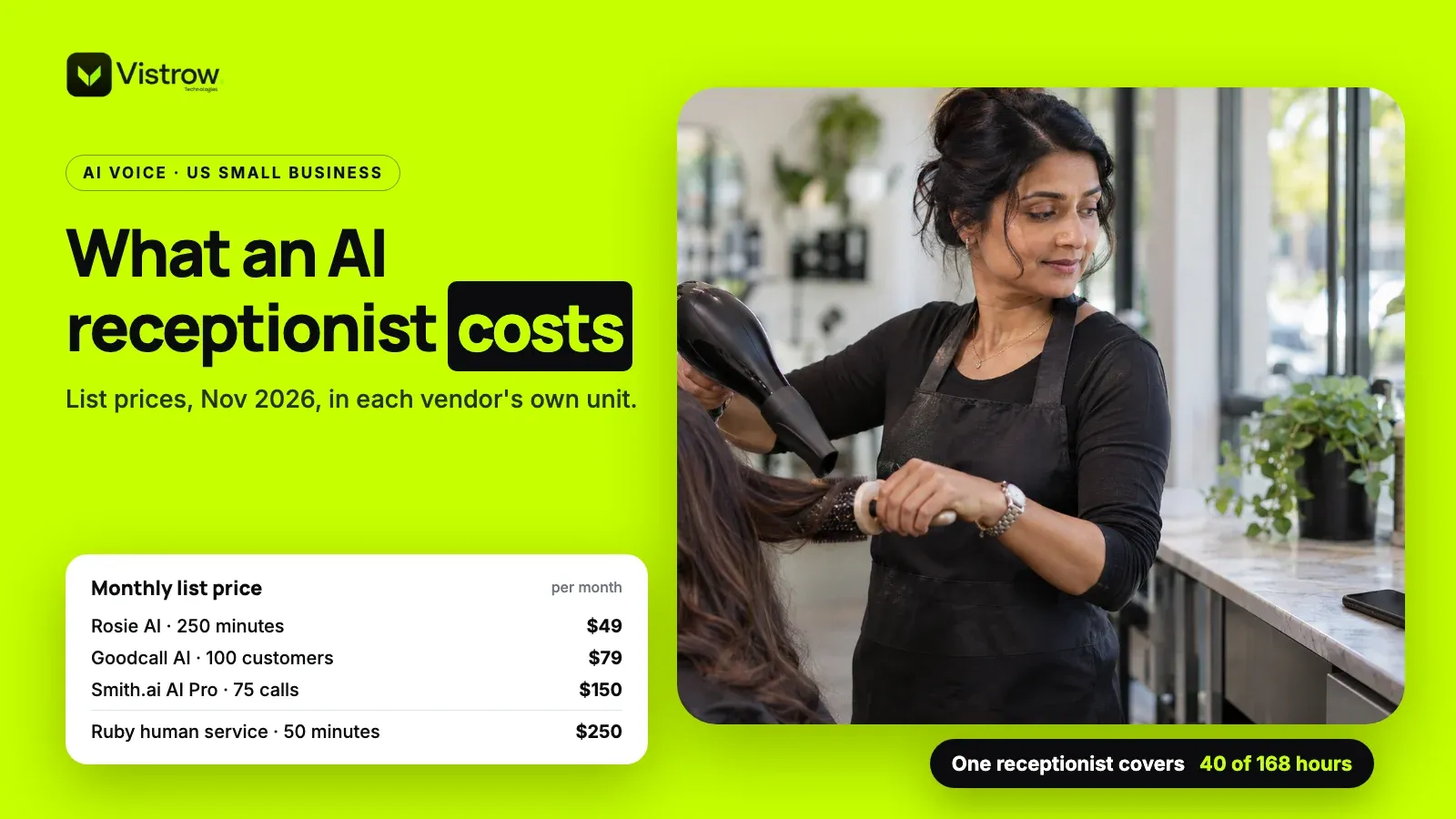
The honest answer is that the headline price tells you little, because each vendor counts something different. Rosie counts minutes, Goodcall counts unique customers, and Smith.ai counts calls. The figures below are vendor list prices read on 4 November 2026, so check the pages before you buy.
Rosie's Professional plan is $49 a month for 250 minutes, Scale is $149 for 1,000 minutes and Growth is $299 for 2,000 minutes, per Rosie's pricing page. Goodcall's Starter is $79 a month for 100 unique customers (about 150 calls), Growth is $129 for 500 and Scale is $299 for 2,000, and it says it never meters minutes.
Smith.ai publishes its AI receptionist pricing as a free tier of 25 calls, Pro at $150 a month for 75 calls then $2.50 per extra call, and Enterprise at $500 a month. Ruby, a human receptionist service, charges $250 a month for 50 minutes, $395 for 100 and $720 for 200.
Convert before comparing. A shop taking 100 calls a month would pay $212.50 on Smith.ai Pro, as worked out above. The same shop on a minutes plan needs to know its average call length first, and on a unique-customer plan, whether repeat callers count once. A plan that looks cheapest on paper can cost more once a busy month pushes you past the allowance.
| Plan | What is counted | Monthly price |
|---|---|---|
| Rosie Professional | 250 minutes | $49 |
| Rosie Scale | 1,000 minutes | $149 |
| Rosie Growth | 2,000 minutes | $299 |
| Goodcall Starter | 100 unique customers (about 150 calls) | $79 |
| Goodcall Growth | 500 unique customers | $129 |
| Goodcall Scale | 2,000 unique customers | $299 |
| Smith.ai AI Free | 25 calls | $0 |
| Smith.ai AI Pro | 75 calls, then $2.50 per extra call | $150 |
| Smith.ai AI Enterprise | 300 calls, higher tiers available | $500 |
| Ruby (human receptionist) | 50 minutes | $250 |
| Ruby (human receptionist) | 100 minutes | $395 |
| Ruby (human receptionist) | 200 minutes | $720 |
How does an AI receptionist compare with hiring one?
The US Bureau of Labor Statistics puts median receptionist pay at $18.27 an hour, or $38,010 a year, as of May 2025. That is before benefits, payroll tax, equipment and sick cover. It is a floor, not the full cost of an employee.
Then look at coverage. A week has 168 hours, and a full-time receptionist covers about 40 of them. Nights, weekends, lunch breaks and the moment they are on another call are all uncovered. An AI receptionist answers in all of those gaps, which is its real selling point, more than the lower price.
That does not make the human obsolete. A person reads tone, makes exceptions and calms a frustrated customer. A sensible setup keeps the person for those moments and lets software pick up everything else. If your front desk is already well staffed in business hours, the AI earns its keep mostly after 5 PM.
One more comparison is worth making. Ruby's human service at 100 minutes costs $395, while a Smith.ai Pro month at 100 calls costs $212.50. The units differ, so this is not a fair fight, but it shows why you should price your own volume rather than trust a feeling that software is always cheaper.
Why do missed calls matter if no industry number exists?
A caller who reaches voicemail often just hangs up and rings the next business. How often exactly? Nobody can say reliably. No industry-wide missed-call rate exists, and any confident percentage you see online should be treated with suspicion.
The closest data point is a 2016 Moneypenny survey, and Moneypenny sells answering services, so it is a vendor figure. It found that 69 percent of callers who reached voicemail did not leave a message. Take it as a sign of caller behaviour, not as a measure of what you personally lose.
The better move is to measure your own. Check your phone log for unanswered calls over two weeks, split by time of day. That tells you whether your gap is after hours, at lunch or during busy jobs, and which plan size you actually need. It also stops you paying for 2,000 customers when 100 would do.
What rules apply to an AI receptionist on the phone?
Three areas deserve a quick check. First, the FCC's declaratory ruling FCC 24-17, adopted on 2 February 2024 and released on 8 February 2024, treats AI-generated voices as artificial under the TCPA. It is mainly about outbound calls needing consent, so a purely inbound setup is less exposed, but any outbound follow-up needs consent first. The full FCC ruling is public.
Second, call recording. Federal law needs the consent of one party, but about 11 states need all parties to agree, including California, Florida, Illinois and Washington, according to the Reporters Committee for Freedom of the Press guide. The simple fix is to announce at the start of every call that it may be recorded.
Third, health information. If you run a clinic, a vendor saying it is careful with data is not the same as being HIPAA compliant, and this post makes no HIPAA claim for any product. Ask for the compliance terms in writing before patient details go anywhere near a call.
Which US small businesses is an AI receptionist a good fit for?
The pattern is owner-run shops, clinics and trades where calls repeat and the owner cannot always pick up. A plumber under a sink, a salon owner mid-haircut and a small clinic after closing all share the same problem: a ringing phone and busy hands. The questions are simple and repeated, such as hours, pricing ranges, service area and booking.
Dental is the clearest example, and it has its own post, Dental Answering Service vs AI Receptionist, and a page for US dental clinics. For contractors, see the page on home services in the US.
It is a poor fit where most calls are emergencies, complex sales or upset customers. A burst pipe call needs a human dispatcher now, not a polite message. A six-figure remodel quote needs a conversation. Even there, an ai receptionist can still work as first cover, as long as there is a clear human handoff for anything it cannot handle.
- Good fit: after-hours calls, busy-hands moments, simple repeated questions
- Good fit: appointment booking with a short, fixed set of options
- Poor fit: emergencies, complex sales and upset or confused callers
- Always required: a handoff to a named person for anything off script
How to test an AI receptionist before you commit
Do not judge a plan from its demo call. Judge it from your own questions and your own accent, with real callers. A free tier or a short trial is enough to learn most of what matters, and the process below takes about a week.
If you want a voice agent built around your own documents and rules, Vistrow Voice is our voice AI product for inbound call handling, with a knowledge base grounded in uploaded documents and escalation rules for handing off to a human. Pricing is not public, and quotes are written after a free audit. Vistrow does not claim US clients or offices, so treat it as one option to evaluate, not a recommendation for every shop.
- 1
Log your real calls
Count unanswered calls for two weeks and note the time of day for each one.
- 2
Write the script
List the ten questions callers ask most, with the exact answers you want given.
- 3
Define the handoff
Decide which callers go straight to a person and which number rings for them.
- 4
Test with a free tier
Ring it yourself and ask friends to try awkward questions, interruptions and unclear requests.
- 5
Convert the pricing
Work out monthly cost at your call volume, using the vendor's own unit, before you sign anything.
Frequently asked questions
What is an AI receptionist?
An AI receptionist is software that answers your business phone with a synthetic voice. It takes messages, answers questions from a script you provide, books or routes callers, and sends you a summary afterwards. It works around the clock, unlike a human receptionist who covers one shift.
How much does an AI receptionist cost per month?
At list prices read in November 2026, plans run from $49 a month for 250 minutes at Rosie up to $500 a month on Smith.ai Enterprise. Vendors count minutes, calls or unique customers, so compare the cost of your own expected call volume, not the headline price.
Is an AI receptionist better than a human receptionist?
Neither is better in every case. An AI receptionist covers nights, weekends and busy moments cheaply, while a human handles upset callers, emergencies and complex sales. Many small businesses use the AI as first cover and route anything difficult to a person.
Is it legal to use an AI voice on business calls?
Generally yes for answering inbound calls, but check the rules. The FCC ruled in February 2024 that AI-generated voices count as artificial under the TCPA, which mainly affects outbound calls needing consent. Recording rules also vary by state, so announce recording at the start of calls.
Which businesses should not use an AI receptionist?
Businesses where most calls are emergencies, complex sales conversations or upset customers are a poor fit unless a human handoff is built in. If every call needs judgment, the AI will mostly collect a name and number and pass it on.
Comments