
A Pune telecaller's job-listing pay is only the start of what a seat costs. Here is how an AI telecaller compares per minute, per connected call and per qualified lead, with a worked table.
Search and explore the blog
Explore the blog
Category
Suggested reading
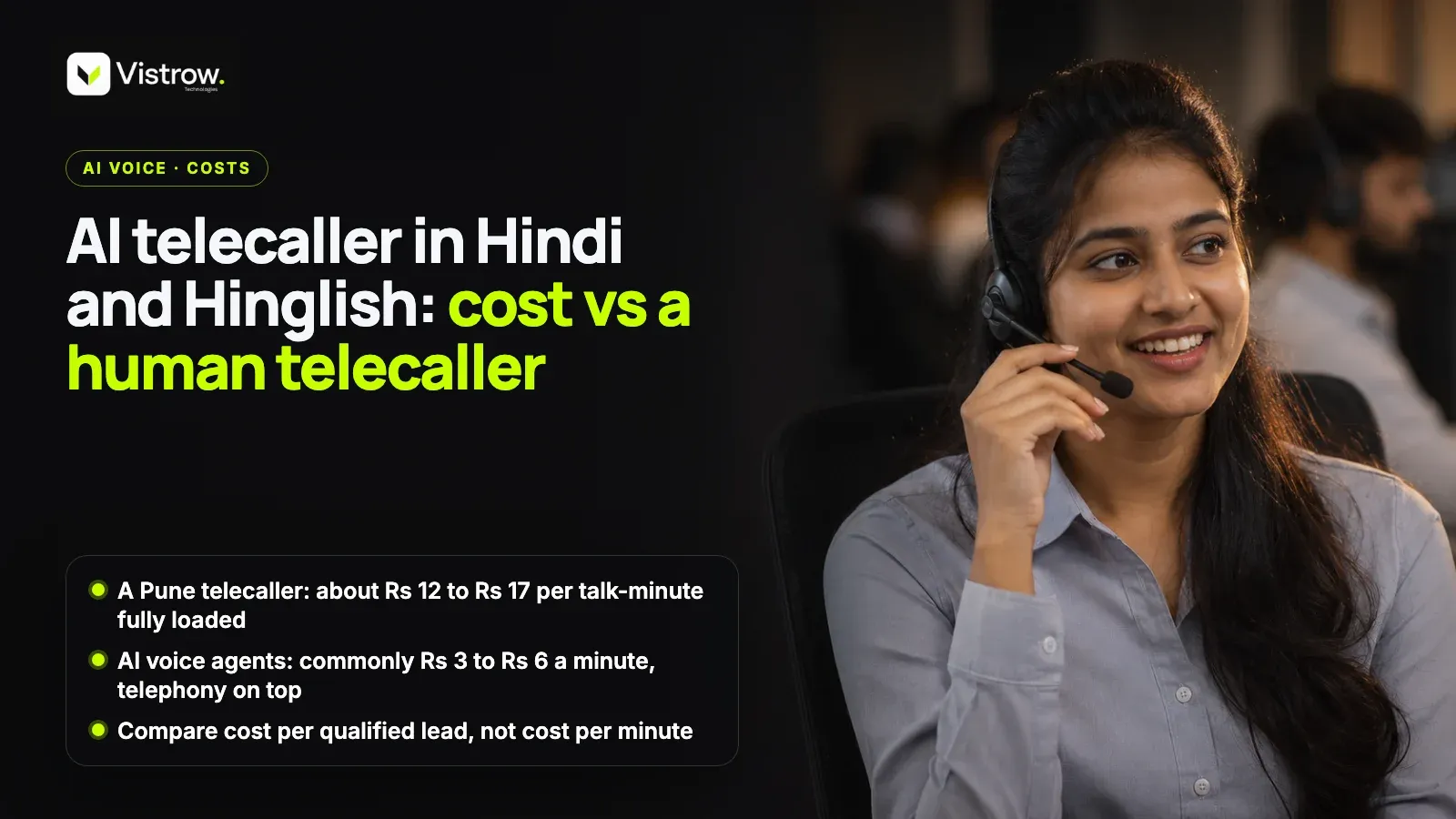
An AI telecaller in India commonly costs Rs 3 to Rs 6 per minute on published rates, plus telephony, against a fully loaded Rs 12 to Rs 17 per talk-minute for a human telecaller in a metro like Pune. Counted per qualified lead, an AI first call with a human closer came out cheaper in our worked example. A human still wins at negotiation and closing.
Here is a common mistake when a Pune sales head prices an AI telecaller. They take the job-listing salary, around Rs 12,000 to Rs 20,500 a month for a telecaller in Pune right now, divide it by the minutes in a month, and conclude that a human costs almost nothing. Then they look at a per-minute AI rate, see Rs 3 to Rs 6, and decide the robot is the expensive option.
Both halves of that calculation are wrong, and they are wrong in opposite directions. A salary is not the cost of a seat, and a headline per-minute rate is not the cost of a conversation. Once you fix both, the picture changes, though not always the way the vendor decks promise.
This post walks through the real numbers as market ranges, builds a worked comparison for 1,000 new enquiries a month, and ends with an honest view of where an AI telecaller earns its place in Hindi and Hinglish calling and where a human should still pick up the phone.
How much does a telecaller in Pune really cost?
Job listings in Pune in September and October 2026 put fixed pay at roughly Rs 12,000 to Rs 20,500 a month. Freshers sit around Rs 12,000 to Rs 18,000 and experienced callers around Rs 15,000 to Rs 20,500. Sales roles add incentives on top, so the number on the offer letter is a floor, not a ceiling.
Then the seat itself costs money. There is a phone and calling plan, a CRM licence, a team lead or manager who spends hours listening to calls and fixing scripts, training for every new hire, and the quiet tax of attrition and leave. Telecalling has high churn, so you are often paying to train someone who leaves before they are good.
Industry analyses translate all of this into a fully loaded human talk-minute of roughly Rs 6 to Rs 10 in tier-2 cities and Rs 12 to Rs 17 in metros. For most Pune teams, the metro end is the realistic one. That is the figure to hold in your head, not the salary divided by thirty days.
How much does an AI telecaller cost in India per minute?
Published rates for AI voice agents in India range from roughly Rs 2 to Rs 12 per minute, with Rs 3 to Rs 6 the common mid-market band. Large committed volumes are reported down to about Rs 1.75 to Rs 2 a minute. If you are searching for an ai calling agent price in India, treat those as market ranges rather than a quote from any single provider.
One public data point is useful. Sarvam's voice agent pricing page lists about Rs 3.50 per minute on pay-as-you-go, and telephony is billed separately. Carrier costs for outbound mobile calls add roughly Rs 0.35 to Rs 0.55 per minute on top. So an ai voice agent price in India is rarely one number; it is a platform rate plus a telephony rate plus whatever your plan adds.
We are not going to state Vistrow Voice pricing here, because it is not public and depends on your volumes and set-up. What we can say is that the same stacking logic applies to every provider, ours included, and you should ask for it in writing before comparing.
The worked comparison: 1,000 enquiries a month
Below is a worked example for 1,000 new enquiries a month. Every figure is an illustrative assumption built from the market ranges above, not a Vistrow result and not a promise. The connect rate in particular is an assumption: we have set it at 35 percent of dial attempts for both sides so the comparison stays fair, and your real number will differ by lead source and time of day.
For the human team we assume Rs 12 per fully loaded talk-minute, at the lower end of the metro range. For the AI first call we assume an effective Rs 6 per minute, which is the top of the common Rs 3 to Rs 6 band, deliberately high to allow for platform fees, telephony and unanswered attempts. In the hybrid model the AI calls every enquiry first and a human closer only speaks to the leads the AI qualified. In both cases we assume 20 percent of connected conversations qualify.
| Line item | Human team only | AI first call + human closer |
|---|---|---|
| Dial attempts (assumed) | 2,500 | 2,000 by AI |
| Connect rate (assumed) | 35% | 35% |
| Connected conversations | 875 | 700 |
| Average call length (assumed) | 3 min | 2 min AI, 5 min human closer |
| Talk minutes | 2,625 | 1,400 AI + 700 human |
| Cost per talk-minute (assumed) | Rs 12 | Rs 6 AI, Rs 12 human |
| Monthly calling cost | Rs 31,500 | Rs 8,400 + Rs 8,400 = Rs 16,800 |
| Qualified leads (20% of connected) | 175 | 140 |
| Cost per qualified lead | about Rs 180 | about Rs 120 |
Why cost per qualified lead beats cost per minute
Notice that the hybrid model produces fewer qualified leads in our table and still wins on cost, because we kept the assumptions conservative. In practice the case for AI is often about speed rather than price. A first call within seconds of an enquiry reaches people while they still remember filling the form, and that can lift the connect rate. We have deliberately not claimed that here, because we would be inventing a number.
The bigger lesson is that effective cost can run two to four times the headline rate once platform fees, telephony and unanswered attempts are included. A vendor quoting Rs 3 a minute may land closer to Rs 6 to Rs 12 per connected minute in your books. That is why we use Rs 6 in the table, and why you should insist on cost per connected conversation and cost per qualified lead rather than a per-minute figure.
One more point of view, gently stated. Many teams treat this as a replace-the-humans decision, and that framing makes the maths look better than it is. The honest saving is in the repetitive first-touch layer, where a human spends most of the shift hearing voicemail, wrong numbers and people who say call me later.
Hindi, Hinglish and Marathi: where an AI telecaller holds up
Indian buyers rarely speak one clean language on a call. They start in Hindi, drop in English for budget and configuration, and sometimes finish in Marathi. An ai telecaller hindi setup has to cope with that mid-sentence switching, not just read a Hindi script back. Vistrow Voice is built for this: it handles inbound, outbound and web calls in 130+ languages, including Hindi, English and 9 more Indian languages, with natural Hinglish and language switching.
Where it works best is the first call, after-hours calls and reminders. When an enquiry arrives at 11 pm, a human team is asleep and a competitor's agent is not. The AI can answer, ask the qualifying questions, ground its answers in uploaded documents such as a brochure or price sheet, and push the outcome and transcript to your CRM through webhooks.
Where it does not hold up is negotiation and relationship calls. A buyer haggling over a discount, an anxious parent comparing admissions, a customer who is upset: these need a person who can read the room and bend the rules. That is why escalation rules matter more than any single language feature. That split is how our lead follow-up systems are set up.
Can an AI telecaller call leads legally?
Cost is only half of the decision, because the calls have to be lawful. Under TRAI rules, calling someone who has enquired with you is treated differently from sending promotional calls to a cold list, and promotional calling is expected to run on the 140 series. An ai telecaller calling people who just filled in your form sits in a very different position from one dialling a purchased database.
Consent and the nature of the call still matter, so keep a record of where each number came from and respect do-not-disturb preferences. We have covered the legal detail separately in our piece on cold calling, DND and DPDP, and you should take advice for your own case. The practical rule is simple: use AI for enquiry follow-up and reminders first, and keep promotional campaigns on the proper series.
How to test an AI telecaller without betting the whole team
You do not need to decide this in a meeting. Run a small, measurable pilot on one lead source, keep your human team in place, and let the numbers argue. The five steps below are the order we would follow for a Pune team handling property or education enquiries.
- 1
Pick one lead source
Choose a single source, such as one ad campaign or a website form, so results are not muddied.
- 2
Write the qualifying questions
Define three or four questions on need, budget and timeline, and what counts as qualified.
- 3
Load your documents
Upload the brochure, price sheet and FAQs so answers stay grounded in what you actually offer.
- 4
Set the handoff rules
Decide when the agent books a visit, routes to a human closer, or ends politely.
- 5
Compare cost per qualified lead
After a month, put the AI-first cohort next to your human-only cohort using the same definition of qualified.
The honest verdict for Pune teams
If you only remember one thing, remember this: an AI telecaller is best at being first, fast and always available, in Hindi, Hinglish and Marathi, and a human is best at closing. The strongest set-up is the combination, with the AI doing the first call and the follow-ups and a human taking over once there is real intent.
To see how this would work on your own enquiry volume, read about AI voice calling at Vistrow and run the cost comparison with your own connect rate and call length. Your numbers, not ours, should decide how much of the first-call layer you hand over.
Frequently asked questions
Is an AI telecaller cheaper than a human telecaller in India?
Per qualified lead, often yes, as the worked example in this post shows, but only once you count platform fees, telephony and unanswered attempts. On a headline per-minute basis an AI agent can look more expensive than a fresher's salary divided by the month. That comparison misleads, because a salary isn't the full cost of a seat.
Can an AI telecaller speak Hindi and Hinglish with real buyers?
Modern agents handle Hindi and Hinglish, including switching language mid-sentence, and some also cover Marathi and other Indian languages. Vistrow Voice works in 130+ languages, including Hindi, English and 9 more Indian languages. Test any agent on your own call recordings and vocabulary, such as project names, localities and fee terms, before you trust a polished demo.
Will an AI telecaller replace my telecalling team?
For most teams, no. It takes over the first call, after-hours enquiries and reminders, so your people spend their time on conversations where judgement and relationships decide the outcome. Negotiation, upset customers and anxious family decisions still need a person who can read the room and bend the rules when it makes sense.
What should I ask an AI calling vendor before signing?
Ask for the all-in cost per connected minute including telephony, what you pay for unanswered attempts, which languages are supported natively, how the handoff to a human works, and whether you get call transcripts and history you can audit. Get the pricing in writing, because platform and telephony rates are often quoted separately.
Can an AI telecaller call leads legally in India?
Calling people who enquired with you is treated differently from promotional calls to a cold list. Promotional calling is expected to run on the 140 series through a registered telemarketer. Keep a record of where each number came from and respect DND preferences. Start with enquiry follow-up and reminders, and take legal advice for anything promotional.
Comments