
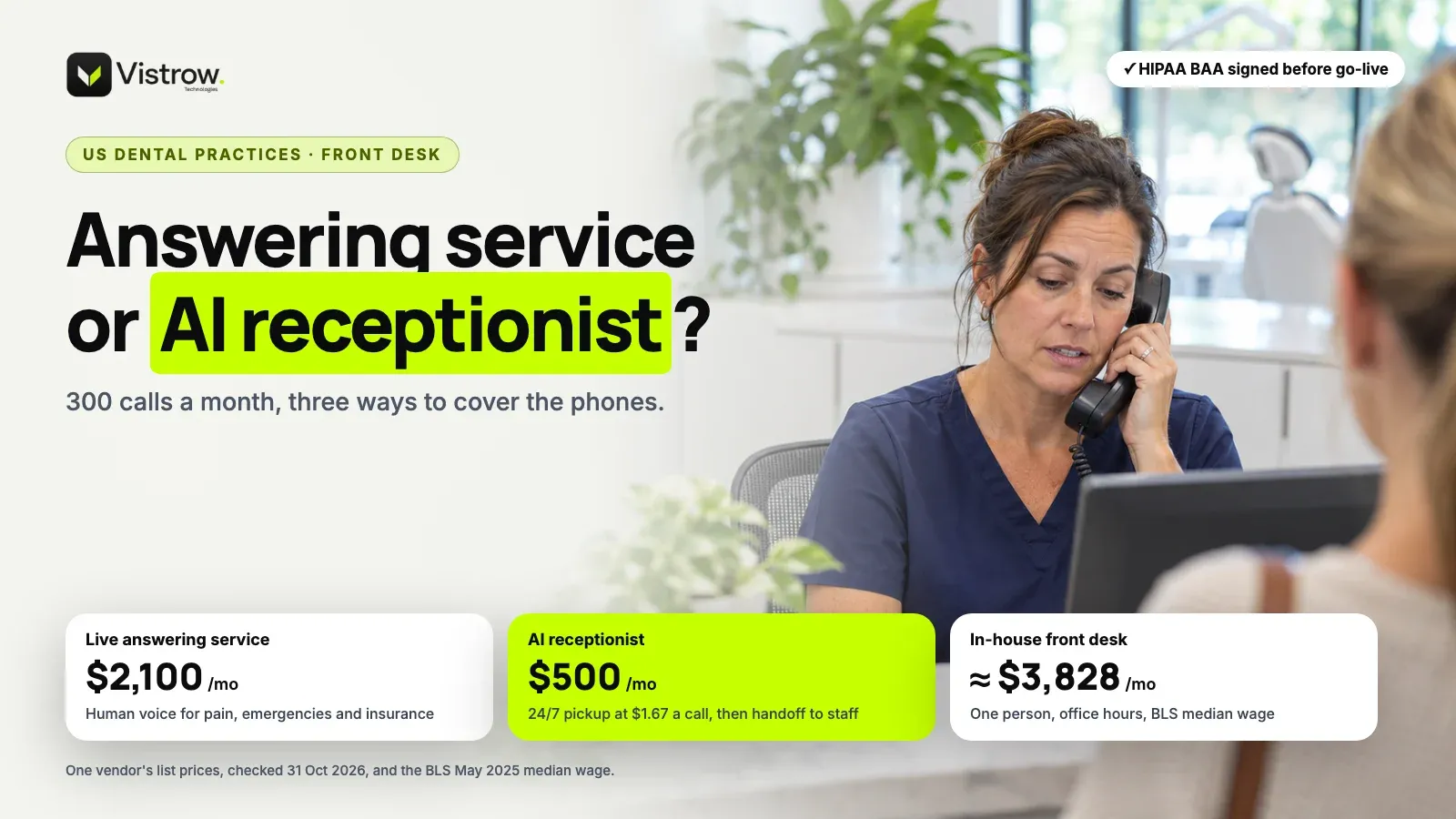
At 300 calls a month, one vendor's live service lists at $2,100, its AI at $500, and a front desk hire costs about $3,828. Here is how a US practice should choose.
Search and explore the blog
Explore the blog
Category
Suggested reading
At 300 calls a month, one vendor's list price is $2,100 for a live receptionist and $500 for an AI receptionist, while an in-house front desk hire costs about $3,828 a month before benefits. A US practice should choose by which calls need a human voice, and many will land on a hybrid. Those figures are list prices, not market averages.
The mistake is treating this as a price contest. A dental answering service, an AI receptionist and a hire each fail in a different place, and the cheapest line on a quote can turn out to be the most expensive on the one call that really matters.
This post lays out the numbers, the HIPAA basics, and a seven-step way to test before you commit. It is written for practice owners and office managers, not for people who already know what a BAA is. If you do, skip to the steps.
What is a dental answering service?
A dental answering service is an outside team that picks up your practice's phone calls when your staff cannot, takes messages, and sometimes books appointments or routes urgent calls. A dental receptionist does the same job in house, usually during office hours only.
An AI receptionist is the newer third option: software that answers calls by voice, handles common questions, collects caller details and hands off to staff. Ask every vendor which one they really are, because some products blend live agents and AI behind the same price.
Underneath, most practices have the same problem. Calls arrive at lunch, during a procedure, after 5 PM and on weekends, exactly when nobody can pick up. That gap is what you are paying to close, so start by measuring it rather than guessing.
It also helps to be honest about what the phone is for. For a dental practice, the phone is how new patients first reach you, how existing patients reschedule, and how someone in pain finds out whether you can see them today. Those are very different jobs, and one setup rarely handles all three equally well.
What does each option cost at 300 calls a month?
Smith.ai lists live receptionists at $300 a month for 30 calls, $810 for 90 and $2,100 for 300, on its receptionist pricing page. Its AI receptionist, on the AI pricing page, lists at $150 for 75 calls ($2.00 a call) and $500 for 300 calls ($1.67 a call). Checked 31 October 2026, and one vendor only.
For in-house, the US Bureau of Labor Statistics put the median wage for medical secretaries and administrative assistants at $45,930 a year in May 2025. That group covers many dental front desks. Divided by 12 it is about $3,828 a month, before benefits, payroll tax and holiday cover.
Read the table carefully. The in-house figure buys one person in office hours only. The other two buy coverage around the clock, but per-call pricing means a busy month raises the bill, so ask what happens to the rate when you go over your plan.
One more point on the in-house number. A person is not only a phone answerer. They check patients in, handle payments and talk to people standing at the desk. So the comparison is not a like-for-like swap. The sensible question is whether outside coverage frees your desk to do the in-person work well, not whether it replaces a salary.
| Option | Monthly cost | What you get |
|---|---|---|
| Live answering service | $2,100 | Human voice, per-call pricing |
| AI receptionist | $500 | 24/7 pickup, $1.67 a call |
| In-house front desk | About $3,828 | One person, office hours only |
Which calls need a person, and which don't?
A live dental answering service earns its price on emergencies, upset patients and insurance questions. A caller with a swollen jaw wants a calm human, not a menu. A patient disputing a bill wants to be heard, and a script that sounds helpful can make that worse.
AI suits the repetitive calls: 24/7 pickup, booking requests, hours and location, new-patient intake, and then a handoff to your team. These are high-volume and low-drama, and they are also the calls that tend to go to voicemail when the desk is busy.
The common advice to buy whatever sounds most human at the lowest price misses the point. Price per call matters less than what happens on the hardest tenth of your calls. So the useful question is not live versus AI. It is which of your call types can tolerate a machine, and which cannot.
A practical way to sort them is to write each call reason on a card and ask one question: if this call went badly, what would it cost us? A missed hours question costs almost nothing. A mishandled pain call can cost a patient, and possibly more than that.
- Human first: dental pain, emergencies, upset patients, insurance and billing questions
- AI first: after-hours pickup, booking requests, FAQs, new-patient intake
- Always offer a clear route to a person, whatever the call type
What should a hybrid setup look like?
A hybrid is AI first, with pain or emergency going to a human. The AI answers every call, deals with the routine ones, and transfers or alerts staff when a caller mentions pain, bleeding, swelling or frustration.
The rules need to be written, not assumed. Define the trigger phrases, who gets the alert, what happens if nobody answers, and what the caller hears while they wait. A vague handoff is where hybrid setups quietly fail.
A hybrid also keeps the live-service bill down. Humans only take the calls that need them, so a plan sized for the emergency and insurance calls can be far smaller than one sized for every call the practice gets.
Keep the AI's job narrow at the start. Let it answer, collect a name, a number and a reason for the call, and promise a callback or a booking request. You can widen it later once the transcripts show it handling those calls well.
Is a dental answering service HIPAA compliant?
Not by default. Under the HHS business associate guidance, an answering service or AI tool that handles patient names, appointments or insurance details is a business associate and must sign a business associate agreement (BAA) with you.
Get the BAA before the first live call, not after the pilot. If a vendor will not sign one, that settles it. Also ask where call recordings and transcripts are stored, how long they are kept, and who on the vendor's side can read them.
Vistrow does not claim HIPAA compliance for its products, and it has no US offices or clients to point to. If you want to talk through a voice setup for a US practice, that happens through a free audit and a quote, not a price list.
This applies equally to a live service and to an AI tool. A friendly human who takes a message with a patient's name and appointment is handling the same information as software is. The paperwork is the same, so do not let either option skip it.
Where does Vistrow Voice fit for a US practice?
Vistrow Voice handles inbound, outbound and web calls in 130+ languages, which matters if part of your patient base speaks Spanish. Answers are grounded in documents you upload, such as your hours, services and new-patient policies, so the agent stays anchored to what you gave it.
It pushes outcomes to your CRM through webhooks, keeps call history and transcripts, and uses controlled escalation and human handoff, which is the part a hybrid depends on. Pricing is not public, and quotes come after a free audit.
For how a practice might structure this end to end, see our page for US dental clinics, and the AI voice calling page for how the calls themselves work. Treat it as a starting point for the conversation, then test any vendor, including us, on your own calls.
How do you choose a dental answering service in seven steps?
Do the groundwork before comparing a single quote. Most bad purchases here come from guessed call volumes and unwritten rules for who handles what.
If you use Dentrix, Eaglesoft or Open Dental, check what each vendor can actually connect to. If nothing connects cleanly, a callback flow is a fair starting point: the service captures the request and your team confirms the slot.
Then run the test properly. Twenty calls is small enough to do in a week and large enough to expose the gaps, and weekly transcript reviews after launch are what keep a decent setup from drifting into a poor one.
When the test is done, compare the three options on your own numbers, not the list prices in this post. Your call volume, your after-hours share and your mix of emergencies will decide the answer far more than any vendor's headline rate.
- 1
Count missed calls by hour
Pull phone logs so you know when calls go unanswered.
- 2
List your top 10 call reasons
Booking, hours, insurance, pain, billing and so on.
- 3
Decide what must reach a human
Write the escalation rules down.
- 4
Check your software or callback flow
Confirm what connects to Dentrix, Eaglesoft or Open Dental.
- 5
Get the BAA signed
No signed BAA, no patient calls.
- 6
Test 20 calls
Include a pain call, an insurance question and an angry caller.
- 7
Review transcripts weekly
Fix gaps in answers and escalation rules.
Frequently asked questions
How much does a dental answering service cost?
It depends on call volume. Smith.ai's published live receptionist prices are $300 a month for 30 calls, $810 for 90 and $2,100 for 300. These are one vendor's list prices, not market averages, so get quotes from two or three providers using your own call counts.
Is an AI receptionist cheaper than a live answering service?
On list prices, yes. Smith.ai's AI receptionist is $150 a month for 75 calls ($2.00 a call) and $500 for 300 calls ($1.67 a call), against $2,100 for 300 live calls. Cheaper does not mean better for every call, especially emergencies and upset patients.
Does a dental answering service need to be HIPAA compliant?
If it handles patient names, appointments or insurance details, it is a business associate under HIPAA and must sign a business associate agreement (BAA) with you. Ask for the BAA before any real patient call goes through, and read what it covers.
Can an AI receptionist book dental appointments?
It can take booking requests, answer common questions and collect new-patient details, then hand off. Whether it books directly into Dentrix, Eaglesoft or Open Dental depends on the integration, so many practices start with a callback flow where staff confirm the slot.
When should a dental call go to a human?
Send dental pain, emergencies, upset patients and insurance questions to a person. Routine FAQs, hours, new-patient intake and after-hours booking requests suit AI. Write these rules down before launch, name who receives each alert, and test the handoff on a few calls so it works the same way at 9 PM as it does at noon.
Comments