
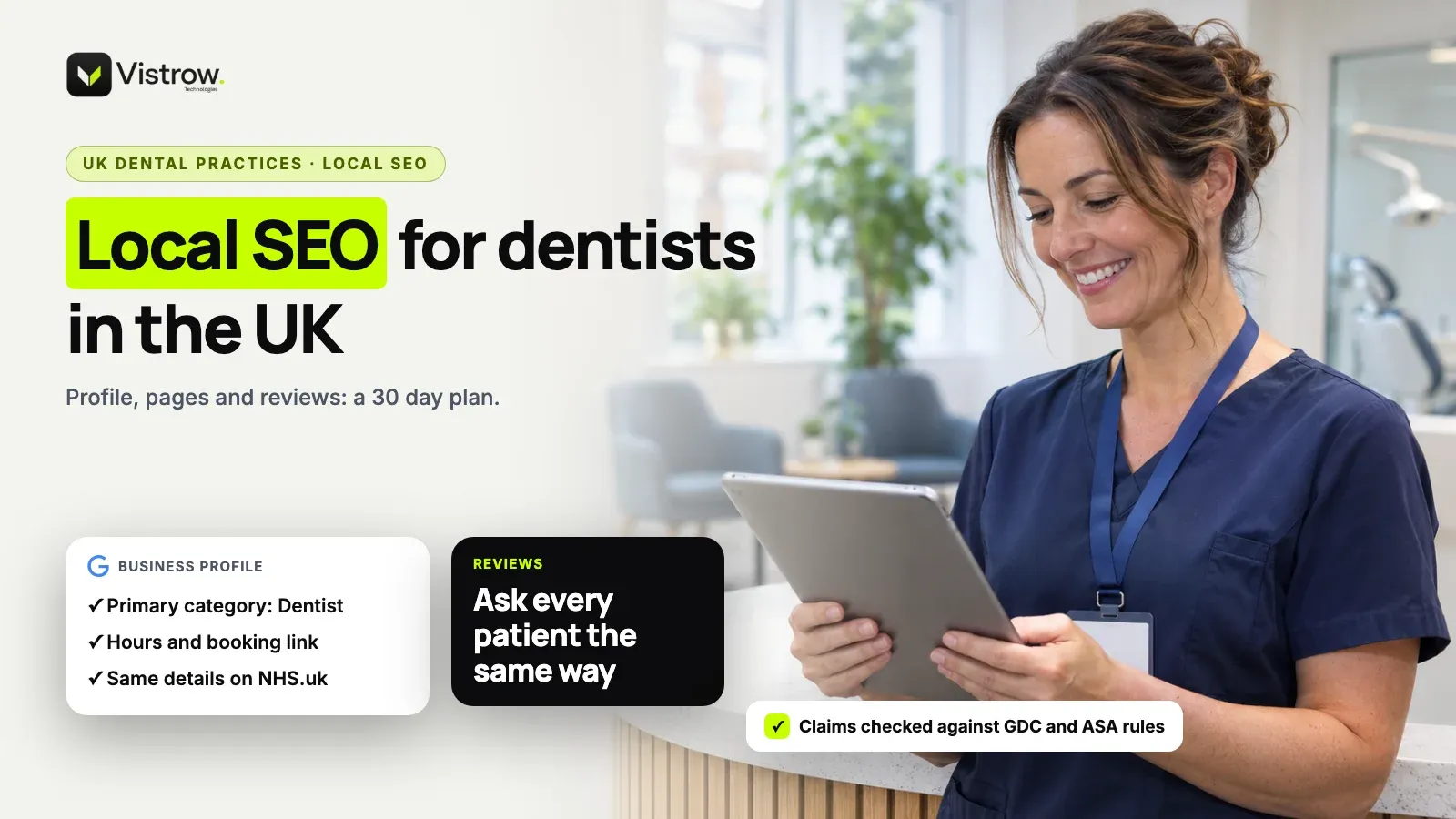
A practical UK guide to local SEO for dentists: set up your Google Business Profile, build treatment pages, ask for reviews safely and check every claim against GDC and ASA rules.
Search and explore the blog
Explore the blog
Category
Suggested reading
- Digital Marketing
MahaRERA QR Code Advertisement Rules: Where It Must Appear and the Penalty
9 min read
- Digital Marketing
Dental Marketing Agency or In-House? Where UK Practices Should Spend on Google, Social and Their Website
10 min read
- Digital Marketing
Landing Page Design Cost in India (2026): What Each Price Band Gets You
8 min read
Local SEO for dentists comes down to three things: a correctly set up Google Business Profile, one useful page per treatment and location, and a steady flow of genuine reviews. Industry surveys such as Whitespark's local search ranking factors report the profile's primary category as the biggest single lever, so start there before touching anything else.
A common mistake is spending money on a redesigned website while the profile still lists the practice under a vague category, with a different phone number from the one on NHS.uk. Fixing that costs an afternoon, not a budget.
This guide covers the UK specifics: the profile, listings, pages, reviews and the advertising rules from the General Dental Council (GDC) and the ASA. It ends with a 30-day plan you can hand to your practice manager.
What does local SEO for dentists actually involve?
Local SEO is the practice of improving how a business appears in location-based search results, such as the map pack Google shows when someone types "dentist near me" or "emergency dentist Leeds". For a practice, it is mostly about relevance, distance and prominence, and you only control the first and third.
In practice that means four jobs. Set up and maintain your Google Business Profile. Keep your details consistent across directories. Build pages that answer what patients search for. Collect and answer reviews properly. Everything else, including most dental SEO UK agency packages, is a variation on these four.
Distance you cannot change. A practice two streets away from the searcher has an advantage that no amount of optimisation overcomes. So the aim is not to rank everywhere, it is to be the obvious choice in the postcodes you actually serve.
It also helps to be honest about what this is not. It is not a trick, and it is not a replacement for good dental practice marketing generally. A patient who finds you through the map still decides on photos, reviews and whether the booking link works.
How do you set up a Google Business Profile for a dental practice?
Begin with the primary category. Choose Dentist. Whitespark's industry survey of local ranking factors, which is a survey of practitioners rather than a statement from Google, consistently reports the primary category near the top. Add secondary categories only for services you really provide.
Then fill in everything Google asks for. Be exact, because patients compare these details with your website and with NHS.uk before they ring. Google publishes its own rules in the Google Business Profile Help centre, and it is worth reading the representing-your-business guidelines before you edit anything.
A profile that is complete and accurate does more for you than one stuffed with keywords. Do not add treatment names to your business name, as that breaches Google's guidelines and can get the listing suspended.
Photos matter more than most practices expect. A patient who is nervous about a visit wants to see the waiting area, the surgery and the faces they will meet. Use recent images taken by the practice, and replace them when the fit-out changes.
- Primary category: Dentist
- Services: list each treatment you offer, such as check-ups, hygiene, emergency appointments, Invisalign or implants, with a plain description
- Opening hours, including bank holiday changes and emergency slots
- Booking link pointing to the real booking page, not the home page
- Photos: the reception, the surgery, the building exterior and the team, taken recently
- Phone number and address exactly as they appear on your website
Why does NAP consistency across NHS.uk, Yell and Bing Places matter?
NAP stands for name, address and phone number. Search engines compare these details across the web to decide whether a business is real and where it is. If one source says Suite 2 and another says Unit 2, or one lists an old mobile number, you create doubt.
Check four places first: NHS.uk, Yell, Bing Places and your own website footer and contact page. Pick one master version of the practice name, address and number, then correct every listing to match it character for character.
Do this before you build any new content. It is dull work, but it is the step practices most often skip, and it is cheap. It also catches problems that hurt patients directly, such as a closed phone line or a wrong postcode that sends them to the neighbouring building.
What goes on a treatment page and a location page?
One page per treatment and one page per location, each with real details. A page called Dental implants should say who places them, what the consultation involves, how long treatment typically takes, where it happens and how to book. Copy-pasted text that only swaps the town name tells Google and patients nothing.
If you have more than one site, give each its own location page with its own address, parking, opening hours, nearest transport and the team based there. Link each treatment page to the location pages that offer it. For a single-site practice, the same page can double as the home page, as long as the details are specific.
This is also where the CMA's expectations come in. The Competition and Markets Authority expects transparent pricing for private treatment, so show a clear price or a starting price and what it includes.
If you rebuild pages, website development planned around this structure is far more useful than a new design alone. Good local SEO for dentists depends on the site answering the questions patients ask, not on how modern it looks.
How should dental practices handle reviews?
Ask every patient the same way. A short link in a text after the appointment, or a card at reception, works. Do not pick only the patients who seemed happy, and do not offer discounts, free whitening or entry into a draw. Incentivised reviews break Google's policy and run against GDC ethics expectations, and review gating (steering unhappy patients away from the public page) is the same problem in a different coat.
Replying needs care. Never confirm that a reviewer is a patient, mention their treatment or refer to their records, even if they have already shared details themselves. Confidentiality still applies to you, whatever they posted.
A reply to a positive review can be as short as thanking them and mentioning the team. Keep it human. Copying the same line forty times looks automated, and readers notice. The steps below work for most negative reviews.
- 1
Wait and read
Read the review twice and check the facts internally, without opening the patient's record to confirm who it is.
- 2
Thank them
Open with a general thank you for the feedback, not for the visit.
- 3
Avoid confirming anything
Do not say they were a patient, name a treatment or mention dates.
- 4
Offer a direct route
Give the practice manager's contact details so the conversation moves offline.
- 5
Learn from it
Log the theme and discuss it at the next team meeting.
Which claims need checking against GDC and ASA rules?
The General Dental Council sets advertising standards for its registrants and expects advertising to follow ASA and CAP rules. Claims must not mislead, and the registration numbers of named dental professionals are expected in advertising. You can read the regulator's wording on the General Dental Council website, and the Advertising Standards Authority publishes the rulings and guidance behind the CAP code.
Three areas catch practices out. First, superlatives such as best, leading or number one, which need evidence you can produce. Second, before and after pictures, which must be genuine, typical and not misleadingly edited. Third, implant wording, where promises about permanence, pain or suitability can easily overstate what you can deliver.
Make this a standing check on any new page, profile description or social post. Someone senior reads it against the rules before it goes live. If you are unsure about a specific claim, check the current GDC and ASA guidance or ask your indemnifier, because this post is not legal advice.
Your first 30 days: a local SEO checklist for a dental practice
Here is a realistic order of work. It assumes one person in the practice owns the project and a marketer or agency helps with the technical parts. The times are rough planning estimates, not benchmarks.
If you want someone to audit the current state first, the SEO and content team can do that, and the UK dental clinics page explains how Vistrow approaches practice marketing. Quotes are written after a free audit, so there is no price to guess at here.
| Task | Time | Owner |
|---|---|---|
| Set primary category to Dentist and add services | 1 hour | Practice manager |
| Check hours, booking link and phone number | 30 minutes | Practice manager |
| Upload recent photos of reception, surgery and team | 1 hour | Practice manager |
| Match NAP across NHS.uk, Yell, Bing Places and website | 2 to 3 hours | Marketer |
| Write or improve one page per main treatment | 1 to 2 hours per page | Marketer and dentist |
| Check every claim against GDC and ASA rules | 1 hour | Principal dentist |
| Start asking every patient for a review the same way | 15 minutes to set up | Reception team |
| Reply to all existing reviews without confirming patient status | 1 hour | Practice manager |
What to do after the first month
Keep the review request running every week, not in bursts. A steady trickle looks more natural and gives you fresh feedback to act on. Check the profile once a month for edits suggested by users, as incorrect hours sometimes slip in.
Add one new treatment or location page a month rather than a dozen at once, and update older ones when prices or staff change. If you also run paid search, performance advertising can cover the gaps while organic rankings build.
Last, do not promise yourself a ranking. Nobody can guarantee one, and anyone who does is selling you something. What you can guarantee is accurate listings, honest pages and a consistent review habit, and that is the part of local SEO for dentists that actually compounds over time.
Frequently asked questions
What is local SEO for dentists?
Local SEO for dentists is the work of making your practice show up when people nearby search for treatment, mainly in the Google map results and local organic listings. It covers your Google Business Profile, consistent directory listings, treatment and location pages, and reviews. It does not involve paying for ads.
Which Google Business Profile category should a dental practice use?
Use Dentist as the primary category. Industry surveys such as Whitespark's local search ranking factors report the primary category as one of the biggest local ranking levers. Add secondary categories only where they truly describe services you offer, such as Cosmetic dentist or Emergency dental service.
Can a UK dentist say they are the best in their area?
Be very careful. The General Dental Council expects advertising to follow ASA and CAP rules, and claims must not mislead. Superlatives like best need evidence you can show. If you cannot prove it, use factual wording about your services, experience and registration instead.
Can I offer patients a discount for a Google review?
No. Incentivised reviews break Google's policy and clash with GDC ethics expectations. Ask every patient the same way, for example with a link after an appointment, and never filter who you ask based on how you think they feel about their visit.
How should a practice reply to a negative review?
Reply politely and briefly without confirming the person is a patient or mentioning any treatment. Say you take feedback seriously and invite them to contact the practice manager directly. This protects confidentiality while showing other readers that the practice responds.
How long does local SEO take for a dental practice?
There is no fixed timescale and nobody can guarantee rankings. Profile fixes and listing corrections are quick to make, while new pages and reviews build up over months. A sensible first step is a 30-day set-up checklist, then steady monthly review requests and page improvements.
Comments