
Most Indian property buyers call instead of filling forms. Here is how a separate virtual number per source, a short IVR and CRM tagging show which ad, hoarding or listing made the phone ring.
Search and explore the blog
Explore the blog
Category
Suggested reading
- CRM & Automation
Dental Appointment Reminders: Text, Email and Call Sequences That Cut No-Shows
10 min read
- CRM & Automation
DPDP Act for Real Estate Marketing: What Builders and Brokers Must Change Before May 2027
9 min read
- CRM & Automation
Lead Management Excel Template for Real Estate Brokers, and When to Move to a CRM
9 min read
A virtual number for real estate is a separate phone number for each ad, hoarding, portal listing or site banner, so the number a buyer dials shows which source made the phone ring and every call is logged against it. That matters in India, where most property buyers pick up the phone instead of filling in a form. Without it, a builder sees calls but cannot say what produced them.
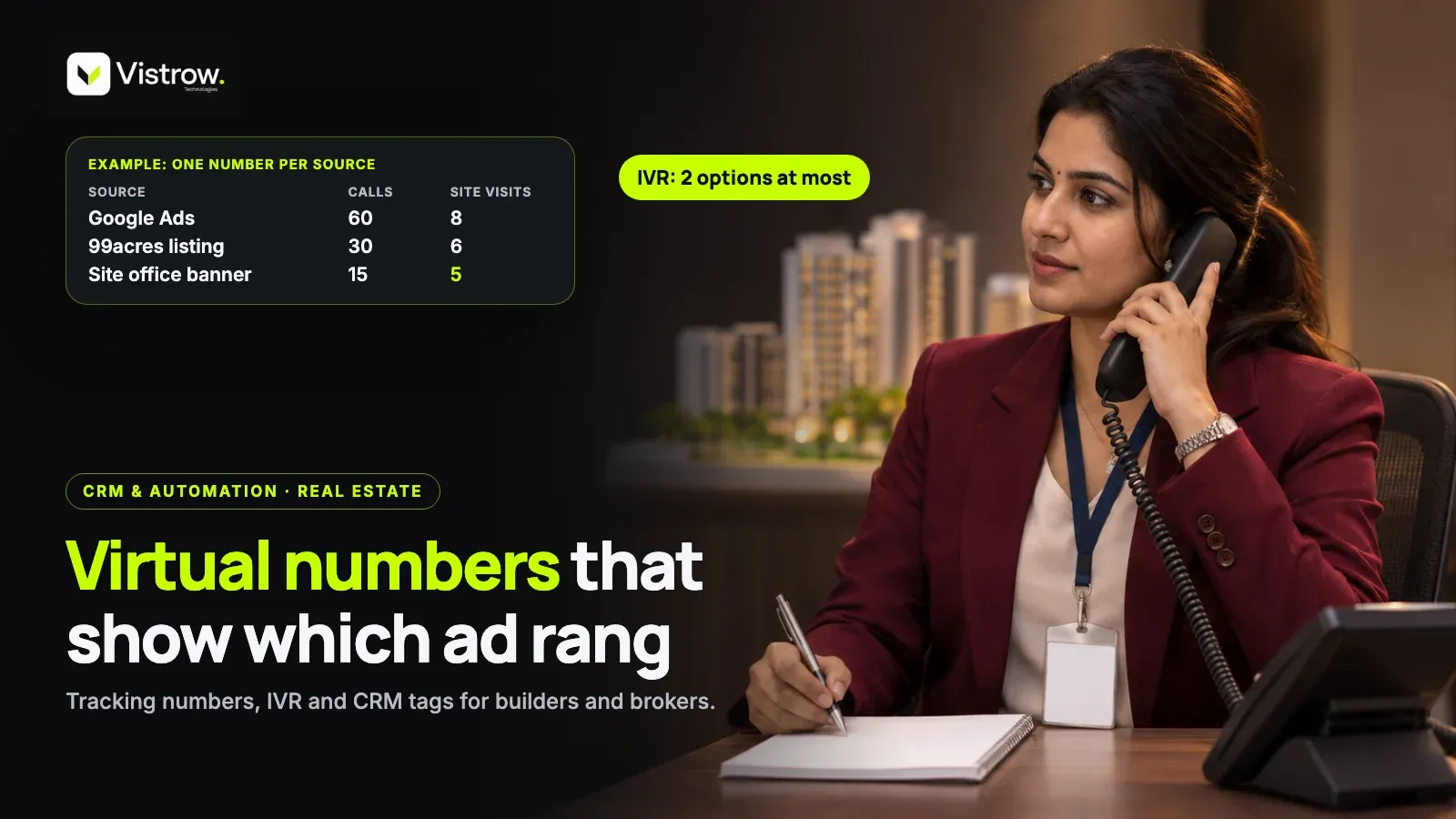
Picture one project with five numbers: Google Ads, Meta ads, a 99acres listing, a hoarding on Baner road and a banner at the site office. At the end of the month the sales head can see which number produced calls, and, more usefully, which produced site visits. That second column is where budget decisions get made.
Most teams do the opposite. One office number is printed everywhere, calls arrive, and someone guesses that the hoarding is working because it looks impressive. This post covers how the setup works, what Google can and cannot tell you, how to build the IVR, and where the TRAI rules start to matter.
What is a virtual number for real estate, and how does it differ from a normal SIM?
A virtual number for real estate is a phone number that is not tied to one physical SIM or handset. Calls to it are forwarded to whoever should answer, such as a telecaller, a sales lead or an IVR, and each call is logged with the time, the caller's number and the duration.
A normal SIM on a salesperson's phone does none of that. When that person leaves, the number goes with them, and the printed hoarding now sends buyers to a stranger. A virtual number stays with the business. You can change who answers without reprinting anything.
The tracking value comes from using many of them. One number per source means the number the buyer dialled is itself the answer to the question of where they saw you. This is what people usually mean by call tracking for real estate, and it needs no clever software to start. It needs discipline about never reusing a number across sources.
Why do Indian property buyers call instead of filling forms?
A buyer standing under a hoarding on a main road is not going to type a URL. They photograph the number or save it, and they call. The same is true of a buyer scrolling a portal listing: the call button is right there, and a call gets a human answer in a minute, which a form does not.
This is why form-only tracking undercounts the channels that matter most for offline media. A hoarding, a newspaper insert or a site banner will show almost nothing in a form report and yet may be producing a steady stream of calls. A builder who judges those channels only by form fills will cut the very spend that is working.
There is a second reason to treat calls as first-class leads. A buyer who calls is usually further along than one who submits a form, but only if the call is picked up and logged. A missed call that nobody records is a lead that vanished without leaving a trace.
One project, five numbers: a worked example
Take a single project with five sources, each given its own tracking number: Google Ads, Meta ads, the 99acres listing, the hoarding on Baner road and the banner at the site office. The table below shows how the monthly review looks. The counts are placeholders labelled example, not real results.
Read it by the last column, not the third. A source with many calls and few site visits is generating curiosity, not intent. A source with fewer calls but a higher share of site visits may deserve more budget. Neither pattern is visible when every call comes in on one office line.
The site office banner is the sleeper in many projects. Buyers who see it are already near the property, so the call to site visit step is short. Whether that holds for a given project only the numbers will say, and that is exactly why the table is worth building.
| Source | Number | Calls this month (example) | Calls that became a site visit (example) |
|---|---|---|---|
| Google Ads | Number 1 | 60 | 8 |
| Meta ads | Number 2 | 45 | 5 |
| 99acres listing | Number 3 | 30 | 6 |
| Hoarding on Baner road | Number 4 | 25 | 4 |
| Site office banner | Number 5 | 15 | 5 |
What can Google Ads call reporting tell you in India?
Google Ads call reporting with Google forwarding numbers is available in India, according to Google Ads Help. It can show that a call came from a search ad and how long it lasted, which is useful for judging the campaign.
The catch is in the same help page. Google says caller phone numbers and caller ID are not shown for some calls in India. For a builder this means Google alone cannot tell the sales team who called, so there is nobody to ring back and nothing to push into the CRM.
If the Google Ads source is set up as in the Google Ads for real estate guide, advertisers can also turn call reporting off, which lets the ad display their own tracking number instead of a Google one. For real estate campaigns this is usually the better setup: use your own number for the Google Ads source, so the call lands in your logs with the caller's number intact, and keep Google's conversion reporting as a second opinion rather than the main record.
How to set up a virtual number for real estate in six steps
The setup is short, but the order matters. Most mistakes come from reusing a number across sources or from letting calls vanish before they reach the CRM. A common one is printing a new brochure with the old office number because the design file was never updated.
Treat the steps below as a checklist for each project. When a new campaign starts, a new number is issued, and the old one is never recycled while printed material is still in circulation. A hoarding can stay up for a year, and a recycled number would quietly credit its calls to the wrong campaign.
- 1
One number per source
Give Google Ads, Meta, each portal, each hoarding and the site banner its own number, and never reuse one.
- 2
IVR menu of two options at most
Ask for the project and the language, then route the call straight to the right person.
- 3
Missed-call alert within minutes
Send the sales lead an alert for any call not picked up, so the buyer is called back quickly.
- 4
Record with a disclosure line
Play a short line saying the call may be recorded before the conversation starts.
- 5
Push every call into the CRM
Create a lead for each call, tagged with the source of the number that was dialled.
- 6
Review cost per site visit monthly
Compare sources by cost per site visit, then move budget towards the ones that earn it.
How should an IVR for real estate be built?
The best IVR for real estate is boring. It asks at most two things: which project the buyer is calling about, and which language they prefer. Those two answers are enough to send the call to the right team member and to start the conversation in a language the buyer is comfortable with.
Resist the urge to add a third option for pricing, a fourth for resale and a fifth for existing customers. Every extra option is another place for a hot lead to give up. If a number is dedicated to one project, as the hoarding number should be, the project question can be skipped entirely and the IVR becomes a language choice alone.
Where nobody can pick up, a missed call number for real estate does a useful job. The buyer rings, the call is logged even if it goes unanswered, and an alert reaches the sales lead within minutes. A callback soon after is often the difference between a site visit and a buyer who has already rung a competitor; the speed to lead guide covers how fast that callback should be.
Where TRAI rules start to matter for tracking numbers
TRAI's rules govern outbound calls. Promotional calls must go out from 140-series numbers, and service or transactional calls by banks, insurers and government bodies use the 1600 series, as set out in TRAI's direction of 19 November 2025 and press release 91 of 2026, published on the TRAI website.
An inbound tracking number that buyers call is a different use. The buyer chose to ring, so answering is not a promotional call. The line gets blurry the moment a team starts a callback campaign from that number to people who did not ask for one. Those calls must follow TCCCPR and DND rules, and a missed call from a stranger is not consent to be marketed to.
A practical rule: call back genuine missed calls promptly, because the buyer asked for contact by dialling. Keep anything promotional on a separate, compliant setup. This is general guidance, not a legal guarantee, so have your telecom compliance adviser check your own arrangement.
Why every call should land in the CRM with a source tag
A call log on its own is a list of numbers. It becomes useful when each call turns into a lead in the CRM, tagged with the source of the number that was dialled. ArthaLeads keeps every lead in one pipeline (New, Contacted, Site Visit, Negotiation, Closed Won) with AI lead scoring from 0 to 100 and AI call intelligence, so the source tag and the call sit on the same record.
Note what ArthaLeads does not do: it does not sell or issue virtual numbers, and portal enquiries from 99acres, Housing.com and MagicBricks are added or imported from a sheet rather than synced live. The number comes from a telephony provider; the CRM is where the call becomes a tracked lead with a pipeline stage.
For calls nobody can answer, Vistrow Voice can pick up inbound and web calls in 130+ languages, including Hindi, English and 9 more Indian languages. It answers from the project documents you upload, hands over to a person when needed, and pushes leads, outcomes and transcripts to the CRM by webhook, so a call at 11 PM still leaves a usable record.
How do you decide where to move the budget?
Once a month, take the source table and calculate cost per site visit for each number. Add up what was spent on the source, divide it by the calls that became a site visit, and compare. Cost per call alone is misleading, because a cheap call that never visits the site is not a bargain.
Move budget in small steps. Shift a portion from the source with the worst cost per site visit to the one with the best, then watch the next month before moving again. Sources with very low counts should be judged over more than one month, since a handful of calls can swing a percentage wildly.
The point is not that one channel is good and another bad. A hoarding may produce fewer calls and still pay for itself through site visits, while a click-heavy campaign may fill the log with calls that go nowhere. A virtual number for real estate turns that argument from opinion into a column the sales head can point at.
Frequently asked questions
What is a virtual number for real estate?
A virtual number for real estate is a phone number that forwards calls to your sales team without being tied to one handset. Builders and brokers use a different one for each ad, hoarding or listing, so every incoming call can be traced to the source that produced it.
Can Google Ads call tracking tell me who called in India?
Not reliably. Google Ads call reporting with Google forwarding numbers is available in India, but Google's help page says caller phone numbers and caller ID are not shown for some calls there. Builders should therefore capture the caller's number on their own tracking line and in their CRM.
How many options should a real estate IVR have?
Two at most. A good IVR for a property enquiry line asks which project the buyer is calling about and which language they prefer, then routes the call. Longer menus make buyers hang up before they reach a salesperson, and every extra option is another chance to lose a hot lead.
Does TRAI allow calling back people who missed-called a tracking number?
A buyer who called you has asked for contact, but callback campaigns to people who did not ask must follow TCCCPR and DND rules. Promotional calls must go out from 140-series numbers. Check your own situation with a telecom compliance adviser before running any callback campaign. This is not legal advice.
Should I record calls on a tracking number?
Recording is useful for training and for call intelligence, but the caller should hear a short disclosure line at the start, such as a note that the call may be recorded. Store recordings safely and keep access limited to the people who need them for coaching or follow-up.
How many tracking numbers does one real estate project need?
One per source you want to measure. A typical project might use five: Google Ads, Meta ads, each portal listing, each hoarding and the site office banner. Never share a number between two sources, and do not recycle a number while printed material carrying it is still in circulation, or calls get credited to the wrong campaign.
Comments