
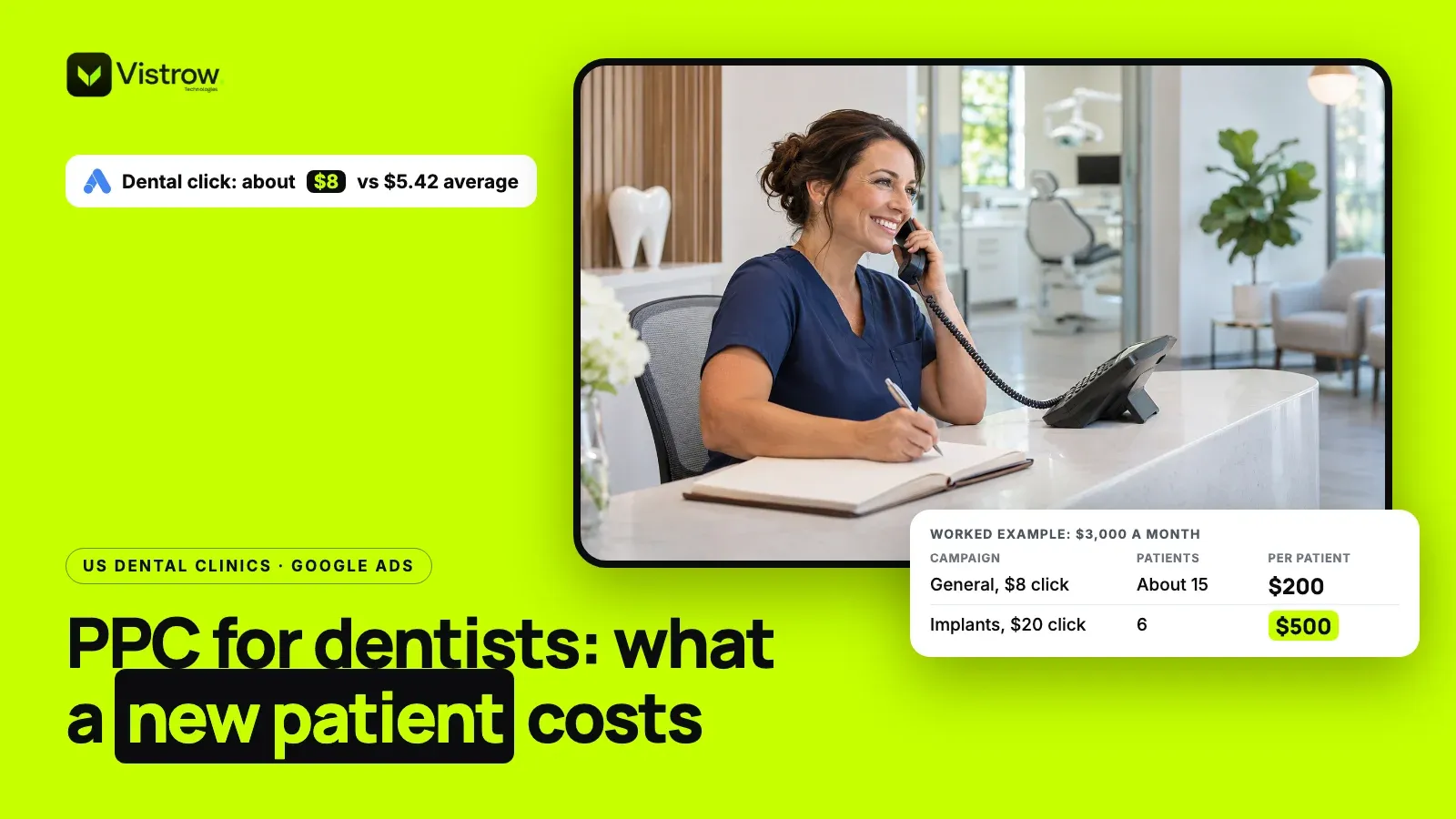
A $3,000 monthly budget at an $8 click works out to about 15 new patients, or roughly $200 each. Here is the math for general dentistry and implants, plus the mistakes that inflate it.
Search and explore the blog
Explore the blog
Category
Suggested reading
- Digital Marketing
Google Business Profile for Real Estate Builders and Brokers: Setup, Reviews and Site Office Listings
8 min read
- Digital Marketing
Local SEO for Dentists in the UK: Google Business Profile, Pages and Reviews
10 min read
- Digital Marketing
MahaRERA QR Code Advertisement Rules: Where It Must Appear and the Penalty
9 min read
Most dental PPC budgets can be judged with one calculation. At an $8 click, $3,000 buys 375 clicks, about 37 leads, and roughly 15 new patients if 40% of leads book and show. That is about $200 per new patient. Swap in implant keywords at $20 a click and the same money buys about 6 patients, near $500 each.
Those are worked examples, not Vistrow results and not a promise. They show why ppc for dentists is less about the click price and more about what happens after the click. A practice that answers every call and sends traffic to the right page can make the same $3,000 do far more than one that does not.
What is PPC for dentists, and what do the published benchmarks say?
PPC for dentists is paid search advertising where a practice bids on terms like emergency dentist near me or dental implants and pays each time someone clicks its ad. The most common platform is Google Ads, because people searching those phrases are usually ready to book.
WordStream-based 2026 summaries put Dentists and Dental Services at about $8.00 average CPC on Google Search, against a $5.42 cross-industry average, and about $73 average cost per lead. Other agency datasets show cost per lead from about $20 to $90 depending on the city. One agency benchmark puts Google Ads at roughly $150 to $350 per new patient.
Treat all of these as published benchmarks, not Vistrow data, and do not assume they apply to your city. A suburb with three competing practices behaves very differently from a downtown market with thirty. Use the ranges to sanity check a proposal, not to predict your own result.
What does a $3,000 budget actually buy?
Take a general dentistry campaign at $8 per click. $3,000 divided by $8 is 375 clicks. If 10% of those visitors fill in a form or call from a landing page, that is 37.5, which we round down to about 37 leads. Divide the budget by the leads and the cost per lead is about $81.
Now assume 40% of those leads actually book and show up. 40% of 37 is about 15 new patients, so the cost per new patient is about $200. That sits inside the $150 to $350 agency benchmark, which is a useful sign the assumptions are reasonable.
Implants change the picture. At $20 per click, $3,000 buys 150 clicks. At 10% that is 15 leads, and at 40% booking and showing, 6 patients. The cost per patient is $500. It looks painful until you weigh it against the value of an implant case, which is a decision for your own numbers, not ours.
Notice that the 40% booking rate carries as much weight as the click price. Raise it to 50% on the general campaign and you get closer to 18 patients from the same spend. That is why phone handling matters so much in any ppc for dentists budget.
| Campaign | Clicks and leads | Patients | Cost per new patient |
|---|---|---|---|
| General dentistry at $8 CPC | 375 clicks, 10% = about 37 leads (about $81 per lead) | About 15 (40% book and show) | About $200 |
| Implants at $20 CPC | 150 clicks, 10% = 15 leads ($200 per lead) | 6 (40% book and show) | $500 |
How to set up PPC for dentists step by step
The order matters. Structure first, then targeting, then tracking. Most wasted spend comes from skipping one of these and launching a single campaign that tries to sell everything.
Start by splitting campaigns by treatment so each gets its own budget, keywords and landing page. A shared pool lets cheap checkup clicks eat the money meant for higher-value cases. Then tie it all to a location radius around the office and make sure calls are tracked.
- 1
Split campaigns by treatment
Separate emergency, implants, Invisalign and general dentistry, each with its own budget.
- 2
Set a radius around the office
Target the area patients will realistically drive to, not a whole state.
- 3
Add negative keywords
Exclude terms like free, jobs and school before spending a dollar.
- 4
Use call extensions and call tracking
Let mobile searchers tap to call, and record which ad produced each call.
- 5
Send ads to treatment landing pages
Match each ad to a page about that treatment, not the homepage.
- 6
Track booked appointments
Measure patients who booked, not only form fills or clicks.
Why implant and Invisalign keywords cost more, and when that is fine
Implant and Invisalign keywords cost several times more per click than cleanings or checkups. The treatment value is higher, so more practices bid, and the auction price follows. Our $20 implant click is an illustration of that gap, not a quote for your market.
A common habit deserves a second look: many practices avoid these terms because the click looks expensive, then pour money into cheap checkup clicks that attract price shoppers. A $500 patient who needs a large case can be a better buy than a $200 checkup patient who never returns. Run the numbers on your own case value before deciding.
If you are planning dental implant marketing, give it its own campaign, its own landing page that explains the process, and a tighter radius. Keep the budget separate so you can see its true cost per patient. Vistrow's performance advertising page explains how campaigns can be structured this way.
What are the most common PPC mistakes dental practices make?
Three mistakes account for a lot of waste. The first is broad match keywords without negatives, which quietly matches searches for free dental care, dental school clinics and dental assistant jobs. You pay for each of those clicks.
The second is sending every ad to the homepage. A person searching for an emergency dentist wants a phone number and an opening time, not a tour of the practice. A treatment-specific page converts better because it answers the exact question that triggered the ad. See our notes on landing pages and funnels.
The third is judging success by clicks. Clicks are cheap to report and say nothing about patients. A campaign with fewer clicks but more booked appointments is the better campaign. If your report does not show booked patients, ask for one that does.
- Broad match without negative keywords
- Homepage as the landing page
- Judging by clicks instead of booked patients
- Missing calls after hours
Review search terms weekly and add negatives
The search terms report shows the actual phrases people typed before clicking. Open it every week. In the first month you will find surprises, and each irrelevant term you exclude stops the leak for good.
Add exclusions such as free, jobs and school as soon as they appear, and keep adding. Also look for the opposite: converting phrases you did not plan for can become their own ad group.
Answering every call is part of the same discipline. A missed call at 7 PM from someone with a broken tooth is a paid click wasted. An answering option, such as Vistrow Voice handling inbound calls with controlled escalation to a human, can cover after hours, though you should check it suits your practice and your legal advice first.
What rules apply to dental advertising in the US?
Google's Healthcare and medicines policy applies to ads in this space, so read the official Google Ads policy before you launch. Keep ad copy factual and avoid outcome guarantees.
Reviews and testimonials are covered by the FTC rule on consumer reviews and testimonials, announced in August 2024. It bans fake or AI-written reviews and testimonials, with civil penalties. The Federal Trade Commission's announcement of the rule explains what it covers, so do not post invented patient quotes on landing pages.
Tracking needs care too. HHS OCR issued guidance on online tracking technologies, and a June 2024 federal court ruling (AHA v. Becerra) vacated part of it. You can read the HHS guidance on online tracking technologies yourself. That does not make the question simple, so ask counsel before sending any patient data to ad platforms. This is not legal advice, and Vistrow does not claim HIPAA compliance.
Should you hire a dental PPC agency?
A dental PPC agency makes sense when nobody on your team can review search terms weekly, build treatment pages and read call tracking. It does not make sense if it reports only clicks and impressions, or refuses to give you ownership of the ad account.
Ask a few direct questions: how do you track booked appointments, how are campaigns split, and how often are search terms reviewed? Vague answers are a warning sign. Quotes from Vistrow are written after a free audit, and you can start with a growth audit to see how your account is set up.
For the US market, see our page for dental clinics in the US. We do not guarantee a cost per patient, because the honest answer depends on your city, your pages and how fast your front desk picks up the phone. Done properly, ppc for dentists is a measurable channel, and the measurement is what separates it from guesswork.
Frequently asked questions
How much should a dentist spend on Google Ads?
There is no single right figure, but $3,000 a month is a workable starting point for one general dentistry campaign in many markets. At an $8 click that buys 375 clicks. Implant campaigns need more, because clicks can cost $20 or higher. Set the budget from the number of new patients you want.
What is a good cost per new patient for dental PPC?
One agency benchmark puts Google Ads at roughly $150 to $350 per new patient. Our worked example lands at about $200 for general dentistry and $500 for implants. These are published benchmarks and assumptions, not guarantees, and your city, competition and phone handling will move the number.
Why are dental keywords so expensive on Google?
Dentistry has high patient lifetime value, so many practices bid on the same searches. WordStream-based 2026 summaries show about $8.00 average CPC for dental services versus $5.42 across industries. Implant and Invisalign terms cost several times more per click than cleanings or checkups.
Can dentists run Google Ads for implants and Invisalign?
Yes, but Google's Healthcare and medicines policy applies, so read it before launching. Keep claims factual and avoid promises about outcomes. Use treatment-specific landing pages, and be careful with patient testimonials, since the FTC rule announced in August 2024 bans fake or AI-written reviews.
Should I hire a dental PPC agency or run ads myself?
If you can review search terms weekly, build treatment-specific landing pages and track booked appointments, in-house can work. Many practices lack that time. A dental PPC agency is worth considering if it reports on booked patients, not clicks, and gives you ownership of the ad account.
Comments