
What UK solar leads really cost (vendor estimates of £7 to £75), which channels bring surveys rather than tyre-kickers, and how the 31 March 2027 VAT date should shape your follow-up.
Search and explore the blog
Explore the blog
Category
Suggested reading
- Lead Generation
Admission Lead Generation in Pune: Cost per Lead and Fake-Lead Filters for Colleges and Coaching Institutes
9 min read
- Lead Generation
Real Estate Lead Generation in Pune: Channels, Rules and a Monthly Plan for Builders and Brokers
9 min read
- Lead Generation
Speed to Lead in Indian Real Estate: How Fast to Call a New Enquiry and How to Get There
8 min read
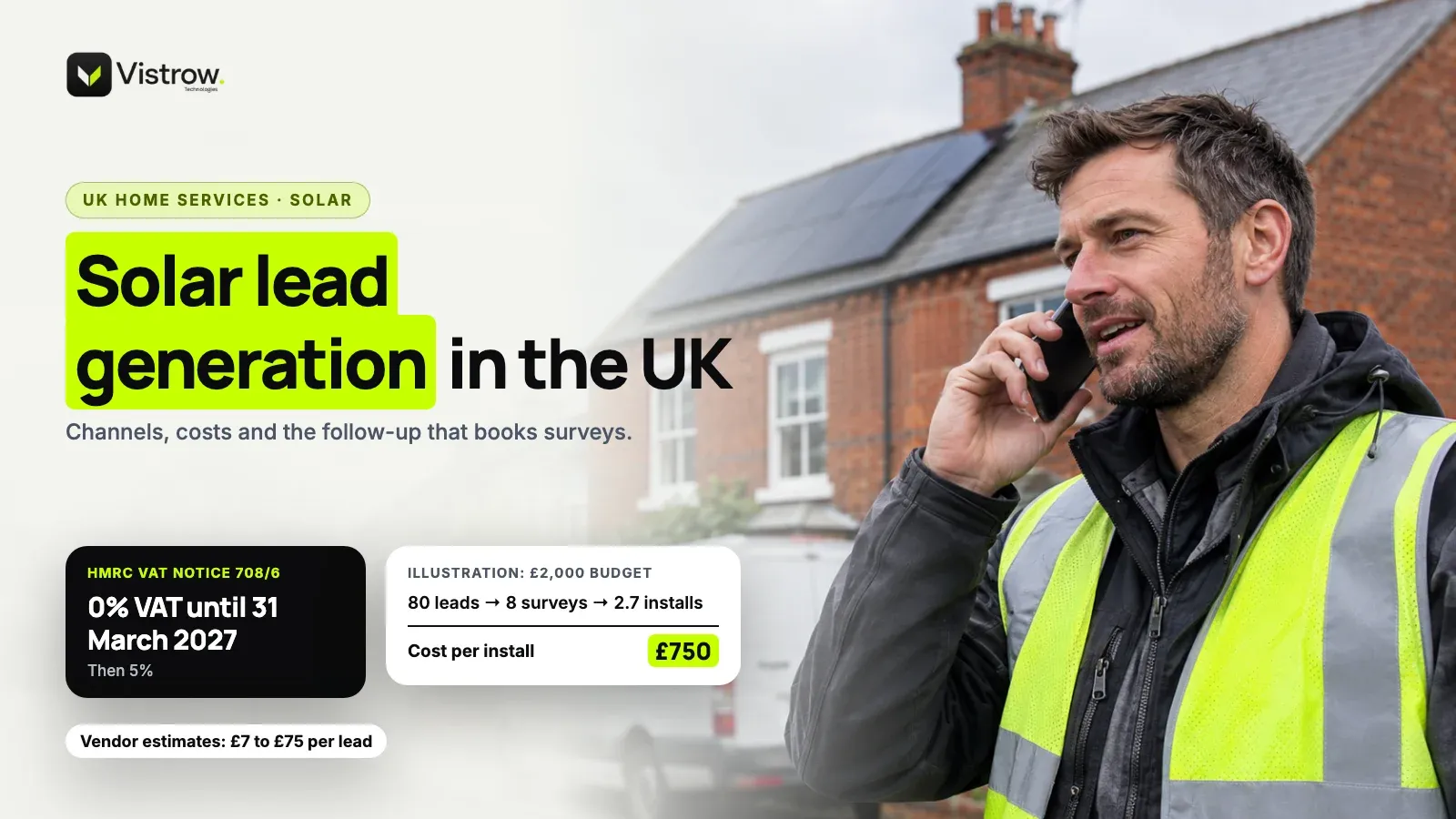
A £2,000 budget at £25 a lead buys about 80 leads. If one in ten books a survey and one in three surveys installs, that is roughly 2.7 installs, or about £750 each. That is illustrative arithmetic, but it shows why solar lead generation should be judged on cost per installation, not cost per lead.
Solar lead generation is the process of attracting homeowners who want solar panels, capturing their details and turning them into booked surveys for an installer. The first half gets all the attention. The second half, what happens in the first hour after an enquiry arrives, usually decides whether the money paid for the lead was well spent.
This guide covers the channels UK installers use, what vendors say leads cost, a worked cost-per-install example, and a follow-up routine. It also covers the one dated deadline, 31 March 2027, that gives you a genuine reason to act now rather than next year.
Why the 31 March 2027 VAT date should shape your campaigns
According to HMRC's VAT Notice 708/6 on energy-saving materials, installing energy-saving materials, including solar panels, in residential accommodation in Great Britain is zero-rated from 1 May 2023 to 31 March 2027. From 1 April 2027 it reverts to the reduced rate of 5%. Do not tell customers the relief has been extended, because the notice gives no such extension.
Why does this matter for marketing? Because it is a real, dated reason for a homeowner to decide. A household that is vaguely thinking about panels has little reason to book a survey this month. A household told honestly that the current zero rate is scheduled to end on a known date has one.
Be careful with the wording. Say what the notice says, point people to it, and avoid promising savings you cannot verify for their specific job. Installation lead times also matter. A survey, design, MCS paperwork and a fitting slot all take weeks, so the practical deadline to book is well before the end of March 2027, and your ad copy and follow-up messages can say so plainly.
Which channels work for solar lead generation?
Each channel trades price against intent and control. Google Ads catches people typing a search for solar panel installers near them, so intent is high and so is the cost of a click. Meta lead ads reach far more homeowners at lower intent, which means more form fills that never answer the phone.
Shared lead sellers and directories are the quickest to switch on, but the same enquiry may go to several installers. Your own website and Google Business Profile are slower to build and cheaper to run once they work. Referrals from past customers, neighbours and trade partners are the cheapest of all, and often the best converting.
A common mistake is relying mostly on bought leads because they are easy to start. A sensible mix of solar lead generation keeps one paid intent channel, one owned channel and a referral habit, and compares them on installs. Good solar marketing starts with judging channels by outcomes rather than form fills.
| Channel | Intent | What to watch |
|---|---|---|
| Google Ads | High | Click costs and whether searchers want a quote or just information |
| Meta lead ads | Lower | Fake or casual form fills; speed of first call matters most |
| Shared lead sellers | Varies | Same homeowner sold to several installers; weekly retainers |
| Directories | Medium | Fees, reviews and how certification is displayed |
| Own website plus Google Business Profile | High once built | Slow to build, cheap to run, needs reviews and clear pages |
| Referrals | Highest | Needs a simple ask after every completed install |
How much do solar leads cost in the UK?
Treat every figure here as a vendor estimate, not an official price. A September 2026 survey by Whito found published prices from 4 of 9 UK suppliers ranging from £7 to £75 per lead, often plus a weekly retainer. The other five did not publish prices at all, which tells you something about how to negotiate.
A lead seller's own guide, from PoweredLeads, puts shared directory leads at £15 to £30, sold to 3 to 5 installers, with exclusive leads at £22 to £30. Notice what that implies. If a shared lead goes to five installers, the homeowner may take five calls in an afternoon and the fastest, most polite caller usually gets the survey.
So a cheap lead is not necessarily cheap. A £7 lead that books a survey one time in fifty costs more per survey (£350) than a £30 exclusive lead that books one in eight (£240). Ask any supplier for their typical survey booking rate, their replacement policy for wrong numbers and whether the retainer is on top. Nothing here is a guaranteed price or volume for your area, and solar lead generation budgets should always be set against installs.
Worked example: from a £2,000 budget to cost per installation
This is illustrative arithmetic, not a Vistrow result and not a benchmark. Say you spend £2,000 at £25 a lead. That is 80 leads. If 1 in 10 books a survey, you get 8 surveys. If 1 in 3 surveys becomes an installation, that is about 2.7 installs.
Divide £2,000 by 2.7 and the cost per installation is about £750. Now change one number. If your team answers slower and only 1 in 15 leads books a survey, you get about 5.3 surveys and about 1.8 installs, so cost per install rises to roughly £1,100 without the lead price moving at all.
That is the whole argument for measuring installs. The lead price is the number the seller controls. The survey booking rate and survey-to-install rate are the numbers you control, and they move the final cost far more than haggling over a few pounds. Conversion tracking that ties each lead source to the install it produced is what makes this visible.
- Spend: £2,000 at £25 a lead gives 80 leads
- 1 in 10 book a survey: 8 surveys
- 1 in 3 surveys install: about 2.7 installs
- Cost per installation: about £750 (illustrative)
Follow-up that wins the survey: answer in minutes, call and text
A homeowner who filled in a form on their phone is comparing you with other installers right now. Answer within minutes, call first, then text if there is no answer, and aim every contact at one outcome: a booked survey. Do not try to quote a price over the phone. Strong solar lead generation is wasted if the first call comes the next morning.
The routine is simple but needs to run on evenings and weekends, because enquiries also arrive outside office hours. Vistrow Voice can answer and call back in English, ask a few qualifying questions about the property and roof, and push the lead and transcript to your CRM through webhooks, with escalation rules for when a person should take over. Quotes are written after a free audit, so there is no fixed price to quote here.
Whatever tool you use, keep human handover obvious. A homeowner with a technical question about batteries or an unusual roof wants a knowledgeable person, and the first call should make it easy to reach one.
- 1
Capture
Lead lands from the form, ad or call and goes straight into one list.
- 2
Call within minutes
Ring first, because voice builds trust faster than a text.
- 3
Text if no answer
Send a short message with your name and a way to pick a survey slot.
- 4
Book the survey
Offer two specific slots rather than asking when suits them.
- 5
Chase politely
Follow up on any survey that has not been confirmed or has been missed.
Calling people who did not enquire: PECR and the TPS
Everything above applies to people who asked to hear from you. Phone or text marketing to people who did not enquire is a different matter. The ICO's telephone marketing guide explains the Privacy and Electronic Communications Regulations (PECR), including the need to screen numbers against the Telephone Preference Service (TPS).
In practice, that means you should not buy a list of numbers and start calling because the list says they own a house with a south-facing roof. Text and automated calls have stricter consent expectations still. If a lead seller says the leads are fine to call, ask how consent was captured and whether it names you or just their partners.
This article is not legal advice, and we make no claim about any particular supplier's compliance. Keep a record of when and how each person asked to be contacted, and read the ICO guidance before running any outbound campaign.
Trust signals that make solar marketing convert
Solar is a large purchase and homeowners know there are poor operators around. MCS, the UK quality mark for small-scale renewables, matters here because homeowners need an MCS-certified installation to be eligible for Smart Export Guarantee payments. Directories such as Checkatrade and TrustMark also feature certification.
Put your MCS status near the top of your landing page and on your Google Business Profile, not buried in a footer. Add real reviews, photos of finished roofs and a plain description of what happens at a survey. Our lead generation work treats the page after the click as part of the campaign, because paying for traffic to a weak page is the most common waste in solar lead generation.
If you are unsure about grant or incentive amounts, do not publish them until you have checked gov.uk. Out-of-date figures cost you credibility faster than anything else. For how this applies to UK trades more broadly, see our UK home services page.
A 30-day plan to test your solar lead generation
Do not commit to a long retainer before you have numbers. Run a small, structured test of your solar lead generation and let installs decide. Keep the plan small enough that you can read every lead personally.
At the end of the month, compare channels on cost per survey and cost per install, not on leads. If sample sizes are tiny, say so and extend the test rather than declaring a winner.
- Week 1: set up call tracking, a lead sheet and a simple landing page that shows your MCS status
- Week 2: launch one Google Ads campaign and one Meta lead ad, with a small daily cap
- Week 3: call every lead within minutes, text if no answer, and log outcomes
- Week 4: add review requests and a referral ask to every completed install
- Month end: compare cost per survey and cost per installation by channel
Frequently asked questions
How much do solar leads cost in the UK?
Published vendor prices vary widely. A September 2026 survey by Whito found prices from 4 of 9 UK suppliers ranging from £7 to £75 per lead, often plus a weekly retainer. One lead seller's own guide puts shared leads at £15 to £30. These are vendor estimates, not official figures.
What is the best channel for solar installer leads in the UK?
There is no single best channel. Google Ads captures high-intent homeowners already searching, Meta lead ads reach more people with lower intent, and referrals plus a strong Google Business Profile cost little. Most installers mix two or three and compare each by cost per installation, not cost per lead.
Is VAT on solar panels in the UK zero-rated?
For residential installations in Great Britain, HMRC VAT Notice 708/6 says installing energy-saving materials including solar panels is zero-rated from 1 May 2023 to 31 March 2027. From 1 April 2027 it reverts to the reduced rate of 5%. Check the notice for the current position.
Are shared solar leads worth buying?
They can be, but check the maths. A lead seller's own guide puts shared directory leads at £15 to £30, sold to 3 to 5 installers, so you compete for the same homeowner. Exclusive leads cost a little more. Track how many book surveys and install before committing.
Can I cold call homeowners about solar panels in the UK?
Only within PECR rules. Marketing calls to people who did not enquire need screening against the Telephone Preference Service, and texts generally need consent. The ICO's telephone marketing guide sets out the rules. Calling people who asked for a quote is a different, much safer situation.
Why does MCS certification matter for solar marketing?
MCS is the UK quality mark for small-scale renewables, and homeowners need an MCS-certified installation to receive Smart Export Guarantee payments. Showing your certification on your website and directory profiles removes a common objection early and supports trust.
Comments