
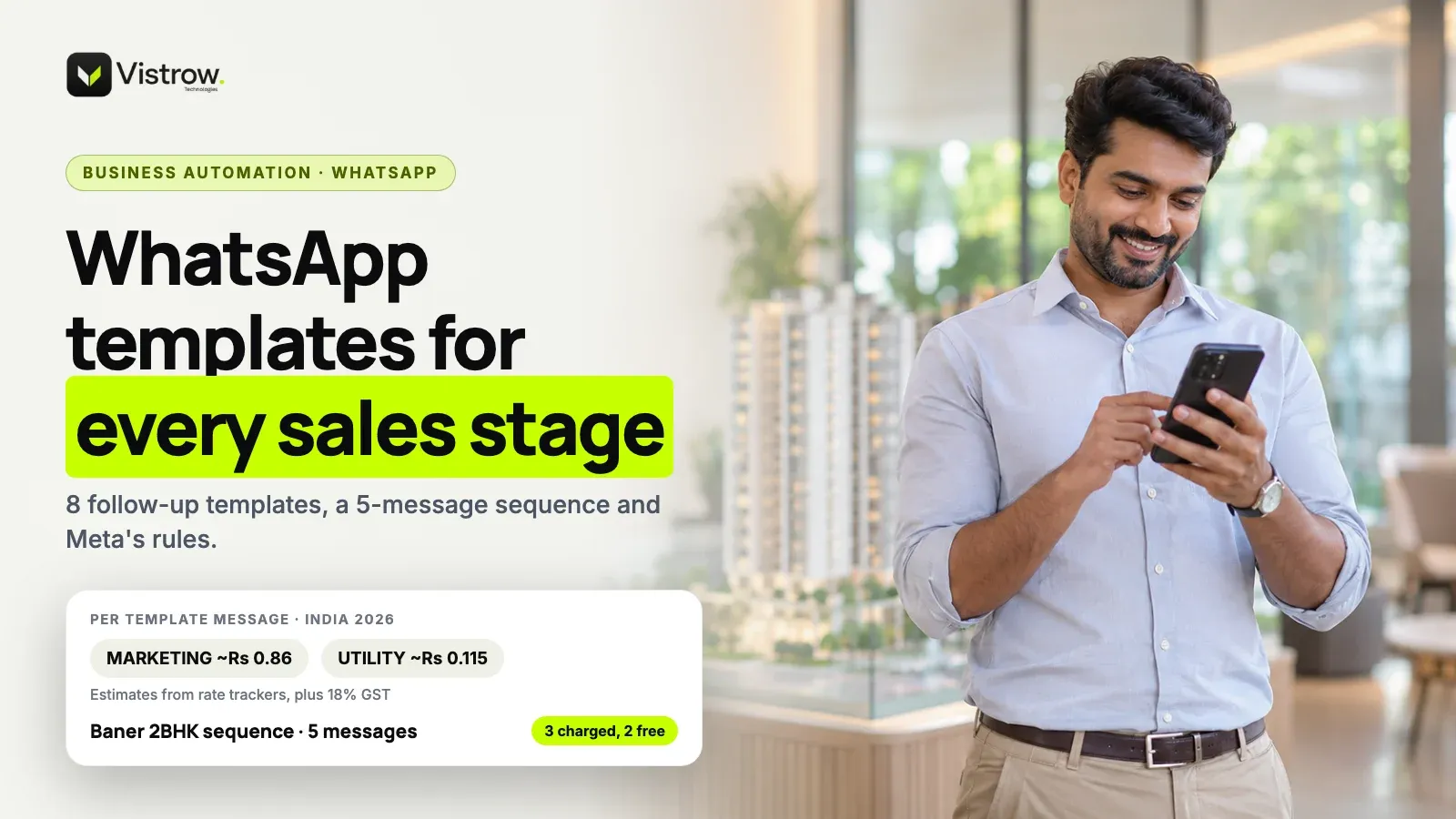
Eight follow-up templates by stage, a 5-message Baner 2BHK sequence marking which messages fall in the free window, and the Meta template rules that decide cost and approval.
Search and explore the blog
Explore the blog
Category
Suggested reading
- Business Automation
DLT Registration for SMS in India: Headers, Templates and Why Messages Get Blocked
8 min read
- Business Automation
WhatsApp Business API Pricing in India (2026): What 2,000 Leads a Month Actually Costs
8 min read
- Business Automation
Marketing Automation Workflows in 2026: Six to Run First and What Each One Needs
8 min read
The first WhatsApp message to a Facebook lead is a paid template, because a form fill does not open the 24-hour window. Replies after the buyer answers are free, and since 1 July 2025 Meta charges per delivered template message. Plan your WhatsApp automation for real estate around that one rule.
A common mistake is sending one template to everyone. The same "Thanks for your interest, call us for a special offer" message goes to a fresh lead, a cold lead from March and a buyer who already visited the site. Meta may read it as marketing, it costs the higher rate, and it is irrelevant to two of the three people.
Below you get eight sample templates by stage, a worked 5-message sequence for a 2BHK enquiry in Baner, and a short setup list. Nothing here is legal advice, and none of the wording is guaranteed to be approved.
What does WhatsApp automation for real estate actually cover?
WhatsApp automation for real estate means using Meta's official WhatsApp Business Platform to send and answer property enquiry messages without a person typing each one. It covers template messages such as the acknowledgement, brochure and reminders, live replies by a chatbot or AI agent, and a hand-off to a human when the buyer is ready to talk.
It is not the same as the WhatsApp Business app on a phone. The app is made for manual chats, one phone at a time. A WhatsApp API for real estate is what lets a CRM send approved templates to a filtered list, route chats to a team and record every message against the lead.
A WhatsApp chatbot for real estate is the live-reply part. It should ask about needs, budget and timeline, share the brochure and location, and then step aside. The last section covers exactly where it should stop.
The reason this matters for a sales team is simple. Buyers compare three or four projects in a weekend, and the developer who answers first with the right brochure and a bookable slot has an advantage in getting the visit. Automation is how a small team answers at 11 PM and on Sunday without anyone staying awake.
How do Meta's template categories and the 24-hour window work?
Per Meta's WhatsApp pricing documentation, templates have three categories: marketing, utility and authentication. Meta reviews each template and can reject it or change its category. You propose a category, but Meta decides, so never build a plan that depends on a template being approved as utility.
The 24-hour customer service window opens when a buyer messages you. Inside it, your replies are free and can be free-form text. Outside it, you can only send an approved template. That single rule shapes the whole follow-up sequence.
One detail catches people out. A Facebook lead form submission is not a WhatsApp message from the buyer, so it does not open the window. Your first message to a form lead has to be a template, and it is charged. If the buyer replies, the window opens and the conversation gets cheaper from there.
This is also why a click-to-WhatsApp ad behaves differently from a lead form. The buyer starts the chat, so the window is already open when your first reply goes out. If you run both ad types, build two short sequences rather than forcing one to fit both. Our comparison of Facebook lead forms and landing pages covers the trade-offs of each.
What do WhatsApp templates cost per message in India?
Since 1 July 2025 Meta charges per delivered template message, and utility templates sent inside an open service window are free. Marketing templates are charged whether or not a window is open. Messages that fail to deliver are not billed as delivered messages.
For India in 2026, third-party rate trackers list about Rs 0.86 per marketing message and about Rs 0.115 per utility message, plus 18% GST. Treat those as estimates, not Meta's published figures, and check Meta's current INR rate card before you budget.
The gap between the two rates is the practical reason to classify honestly. A confirmation of a visit the buyer already booked is utility. A brochure with a launch offer is marketing. Trying to slip an offer into a utility template tends to backfire, since Meta can simply change the category and bill the higher rate.
For a full monthly breakdown, see our guide to WhatsApp Business API pricing in India.
Eight WhatsApp templates for real estate, one per stage
These are sample structures for WhatsApp templates for real estate, not pre-approved wording. Meta may change the category of any of them. Variables use the {{1}} format, and we recommend keeping them to name, project, date and time.
An English example: "Hi {{1}}, thanks for your enquiry about {{2}}. Your site visit is booked for {{3}} at {{4}}. Reply here if you need to change it." The Hinglish version: "Namaste {{1}}, {{2}} mein interest dikhane ke liye shukriya. Aapki site visit {{3}} ko {{4}} baje book hai. Badalna ho to yahin reply kijiye."
Notice that neither carries an offer or a price. That is deliberate for anything you want treated as utility. The price quote follow-up and the cold lead revival are the two that belong in marketing, so they get an opt-out line and they cost the higher rate.
Use Hinglish where your buyers actually write it. Matching the language a buyer writes in makes it easier for them to reply, and a reply is what opens the free window.
| Stage | Likely category | When it can be sent | Variables |
|---|---|---|---|
| New enquiry acknowledgement | Utility | Right after the lead form, with opt-in | {{1}} name, {{2}} project |
| Brochure share | Utility or marketing | After the acknowledgement; free as a reply if the window is open | {{1}} name, {{2}} project |
| Site visit confirmation | Utility | After the buyer agrees a slot | {{1}} name, {{2}} project, {{3}} date, {{4}} time |
| Day-before reminder | Utility | The evening before the visit | {{1}} name, {{3}} date, {{4}} time |
| Post-visit feedback | Utility | A few hours after the visit | {{1}} name, {{2}} project |
| Price quote follow-up | Marketing | After a quote is shared and the window has closed | {{1}} name, {{2}} project |
| Cold lead revival | Marketing | Weeks after last contact, with opt-out line | {{1}} name, {{2}} project |
| Payment due reminder | Utility | Before a booked buyer's due date | {{1}} name, {{2}} project, {{3}} date |
A 5-message sequence for a Baner 2BHK enquiry
Take a buyer who fills a Facebook lead ad for a 2BHK in Baner on a Thursday and agrees to a Saturday 11 AM visit. The timings below assume the buyer replies to the first message within minutes. If they never reply, no window opens and every message after the first is a template.
The first message sits outside any window because a form fill is not a WhatsApp message. Once the buyer replies, messages two and three fall inside the free service window, and a utility template sent there is free too. By Friday evening the window has usually closed, so the reminder is a paid utility template.
Added up, a buyer who replies early costs you roughly three charged utility messages across the whole sequence, at an estimated Rs 0.115 each plus GST. The saving comes from the reply, which is why the first template should invite one rather than push a brochure link and go quiet.
The Saturday afternoon message is the point where automation ends. A feedback template goes out, and whatever the buyer says, a person should call the same day.
- Message 1, about 1 minute after the lead form: acknowledgement template in English or Hinglish. Outside the window, charged as utility.
- Message 2, about 15 minutes later: brochure and location pin. Inside the free window if the buyer replied to message 1.
- Message 3, Thursday evening: site visit confirmation for Saturday 11 AM. Inside the window if the buyer replied within 24 hours, so free.
- Message 4, Friday evening: day-before reminder with date and time. Likely outside the window, so a charged utility template.
- Message 5, Saturday afternoon: post-visit feedback. Outside the window, charged as utility, and the cue for a person to call.
Six steps to set it up and lower the risk of rejection
Most template trouble comes from consent and wording, not from the technology. Work through these in order, and test small before you send to a full lead list.
Consent is the step teams skip, because it feels like a legal chore. It is also the cheapest fix. One line on the lead form gives you a recorded yes, and it lets your CRM skip anyone who said no before a marketing message goes out.
- 1
Get opt-in on the lead form
Add a clear WhatsApp consent line or checkbox, so every lead has a recorded yes.
- 2
Keep variables to name, project, date, time
Fewer variables mean fewer mistakes and a cleaner review.
- 3
No offers in utility templates
A discount line can get the template reclassified as marketing at the higher rate.
- 4
Add an opt-out line to marketing ones
Something like "Reply STOP to opt out" respects the buyer and reduces complaints.
- 5
Test on one number first
Send each template to a team phone and check every variable fills correctly.
- 6
Hand hot chats to a person
When a buyer asks about price or negotiation, route the chat to a sales executive.
Where should a WhatsApp chatbot for real estate stop?
Early in the chat, a bot earns its keep. At 11 PM a buyer asks about possession dates, and an answer within seconds beats a reply the next morning. After the basics are done, the bot should pass the baton.
ArthaLeads does this with a 24/7 WhatsApp AI agent on the Growth and Enterprise plans, in English, Hinglish, Hindi and Marathi. It asks about needs, budget and timeline, shares the brochure and location, books site visits and saves the answers on the lead. Your team can take over any chat at any point.
Cost control matters as much as the replies. In ArthaLeads, Meta charges come from a prepaid credit balance with a statement of every charge, and there is a free monthly allowance of service replies. Speed matters too, as our guide to speed to lead explains.
Our view: automate the acknowledgement, the brochure, the booking and the reminders. Keep price talks and objections with a person, because that is where site visits turn into bookings.
Frequently asked questions
What is WhatsApp automation for real estate?
It is the use of the WhatsApp Business Platform to send and answer property enquiry messages without a person typing each one, such as acknowledgements, brochures, site visit confirmations and reminders. Templates cover messages sent outside the 24-hour window, a chatbot or AI agent handles live replies, and a sales person takes over once the buyer is serious.
Do I need the WhatsApp API for real estate follow-up?
Yes, if you want automated messages to many leads. The regular WhatsApp Business app is built for manual chats. Approved templates, campaigns to lead lists and a shared team inbox run on Meta's official WhatsApp Business Platform, which you usually reach through a provider or a CRM.
Which WhatsApp template category is a site visit reminder?
A site visit confirmation or reminder is likely to be treated as utility, because it relates to an action the buyer already agreed to. Meta reviews every template and can change its category, so keep offers and promotional wording out of it. Approval and category are never guaranteed in advance.
How much does a WhatsApp template message cost in India?
Third-party rate trackers list about Rs 0.86 per marketing message and about Rs 0.115 per utility message in India for 2026, plus 18% GST. Treat these as estimates and check Meta's current INR rate card. Utility templates sent inside an open service window are free.
Can I message leads from a Facebook lead ad on WhatsApp?
Only with opt-in. Add a clear WhatsApp consent line or checkbox on the lead form. A form submission does not open the 24-hour window, so your first message must be an approved template. Marketing messages should also carry an opt-out line.
Comments