
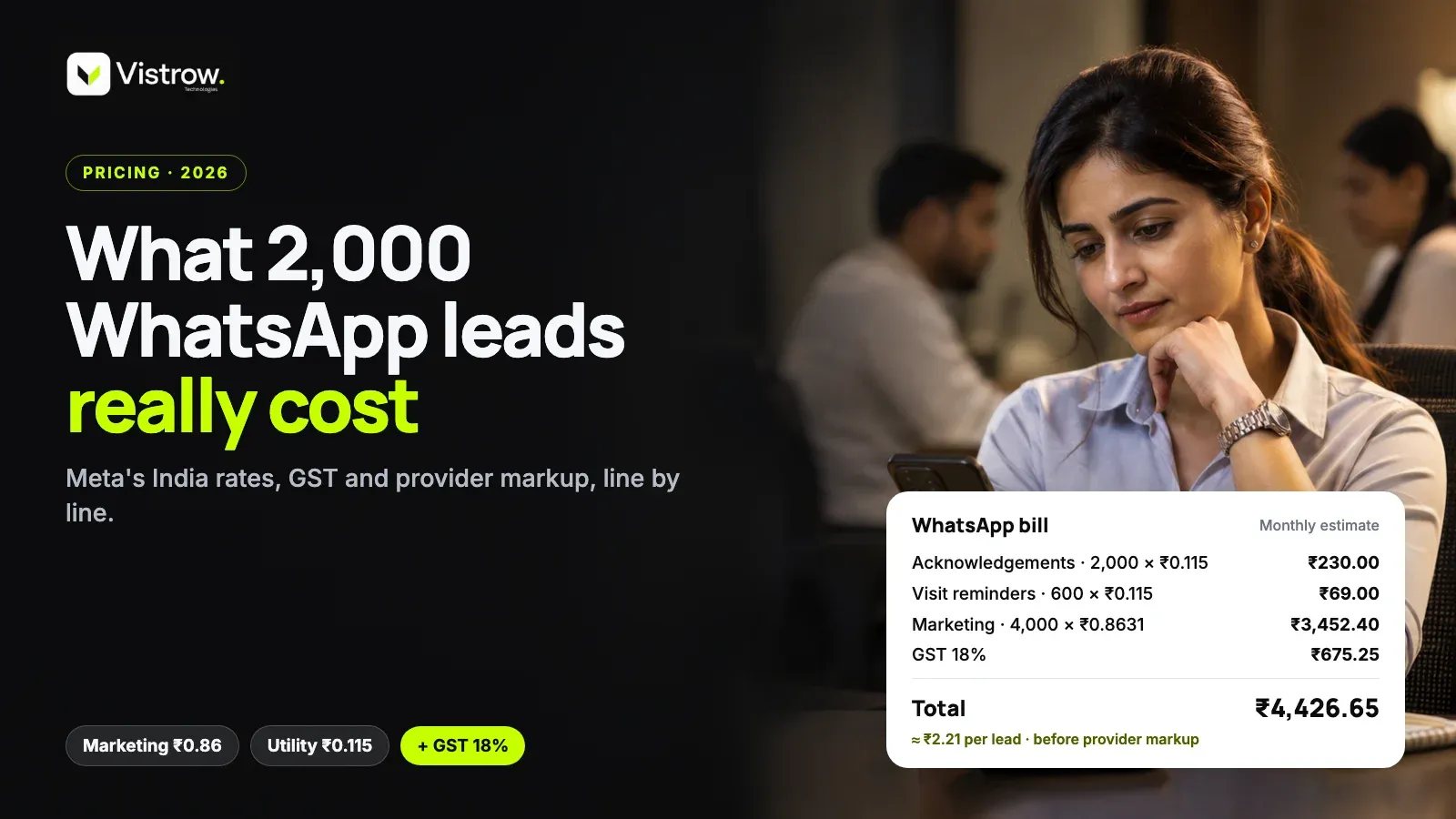
Marketing messages cost about Rs 0.86 each and utility messages about Rs 0.115. Here is the line-by-line bill for a real estate team with 2,000 leads a month, with GST and BSP markup included.
Search and explore the blog
Explore the blog
Category
Suggested reading
- Business Automation
DLT Registration for SMS in India: Headers, Templates and Why Messages Get Blocked
8 min read
- Business Automation
WhatsApp Automation for Real Estate: Follow-up Templates for Each Stage and Meta's Rules
9 min read
- Business Automation
Marketing Automation Workflows in 2026: Six to Run First and What Each One Needs
8 min read
WhatsApp Business API pricing in India is charged per delivered template message, by category. The widely reported 2026 list rate is about Rs 0.8631 for a marketing message and Rs 0.115 for utility and authentication, before 18% GST and any provider margin. For 2,000 leads a month, two marketing messages each cost about Rs 3,452, while acknowledgements and reminders add under Rs 300.
This post walks through how Meta bills, the India rates widely reported for 2026, and a worked estimate for a real estate team with 2,000 leads a month. It is an estimate built from list rates, not a client invoice. Rates change, so check Meta's own page before you put any WhatsApp Business API pricing number into a budget.
How does Meta bill the WhatsApp Business API?
Meta charges per delivered template message, and the price depends on the category of the template, not on how long the message is. The categories are marketing, utility, authentication and, for OTPs sent to Indian numbers from a business account registered outside India, authentication-international. You can read the structure on Meta's official WhatsApp pricing documentation, which is the page to trust over any blog, including this one.
There is no monthly fee from Meta itself for the API. You pay for what gets delivered. If a template fails to deliver, you are not charged for it, which is a small but real reason to keep your lead phone numbers clean.
Category is decided by Meta, not by you. If a template you filed as utility reads like a promotion, Meta can re-classify it as marketing and bill it at the higher rate. Teams often discover this only when the month-end statement looks heavier than their send plan.
What is WhatsApp Business API pricing in India in 2026?
The rates below are the India figures widely reported for 2026. Marketing went up roughly 10% on 1 January 2026, from about Rs 0.7846 to about Rs 0.8631. Utility and authentication sit far lower, which is the whole reason category discipline matters. Treat these as list rates before GST and before any provider margin, and remember that WhatsApp Business API pricing is a moving target. Meta publishes the current rate card on its WhatsApp Business Platform pricing page.
| Message category | Reported rate (Rs) | What it is used for |
|---|---|---|
| Marketing | about 0.8631 | Launches, price updates, offers |
| Utility | 0.115 | Enquiry acknowledgement, visit reminders |
| Authentication | 0.115 | OTPs and login codes |
| Authentication-international | about 2.30 to 2.50 | OTPs to Indian numbers from an account registered outside India |
The worked example: 2,000 leads a month
Here is the scenario. A real estate team gets 2,000 new leads a month. Every lead gets one utility message acknowledging the enquiry. About 15% of leads book a site visit, which is 300 people, and each of them gets two utility reminders before the visit. Finally, the whole list of 2,000 gets two marketing messages that month, for example a new launch and a price update.
The arithmetic is simple, and it is worth doing line by line because the marketing line dwarfs everything else. This is the Meta cost alone. GST at 18% goes on top, and then whatever your provider adds.
| Line item | Calculation | Cost (Rs) |
|---|---|---|
| Enquiry acknowledgements (utility) | 2,000 x 0.115 | 230.00 |
| Site visit reminders (utility) | 300 leads x 2 = 600 x 0.115 | 69.00 |
| Marketing messages | 2,000 x 2 = 4,000 x 0.8631 | 3,452.40 |
| Meta charges subtotal | 230 + 69 + 3,452.40 | 3,751.40 |
| GST at 18% | 3,751.40 x 0.18 | 675.25 |
| Total without BSP margin | 3,751.40 + 675.25 | 4,426.65 |
| Total with a hypothetical 10% BSP markup | (3,751.40 + 375.14) x 1.18 | 4,869.32 |
What that number tells you
Divide the totals by 2,000 and you get roughly Rs 2.21 per lead without a provider margin and about Rs 2.43 with the hypothetical 10% markup. For a lead that may have cost several hundred rupees to acquire through ads, that is small. The cost of WhatsApp is rarely the problem; the cost of wasting it is.
The sharper point is the split. Marketing messages are about 92% of the Meta charge in this example, even though the team only sends two of them per lead. The three utility messages a visiting lead receives together cost less than half of one marketing message. So if someone tells you to cut WhatsApp cost, the honest answer is almost always to send fewer, better-targeted marketing templates, not to stop acknowledging enquiries.
If you want to see how this plays out for property teams in particular, our note on real estate workflows covers where WhatsApp sits in a typical site visit funnel.
Where the real bill comes from
The real bill is Meta rate plus 18% GST plus whatever your BSP adds. A BSP, or business solution provider, is the company you buy API access through. Some charge a markup on each message, some charge a monthly platform fee, and some do both. Two providers quoting the same Meta rate can end up very different once those lines are added.
So when you compare WhatsApp Business API pricing quotes, ask for the all-in cost per category, and ask whether the platform fee is per number, per user or flat. Also ask whether charges are shown line by line. A statement you cannot audit is a statement you cannot optimise.
Vistrow does not resell WhatsApp at a fixed rate and we are not going to quote one here. What we can say is how ArthaLeads handles the mechanics: it is built on Meta's official WhatsApp Business Platform, Meta message charges are paid from a prepaid credit balance, and there is a statement of every charge so a sales head can see what each campaign cost.
The service window change from 1 October 2026
Until now, replies you send inside the 24-hour customer service window, after a lead messages you, have been free. From 1 October 2026, service replies are reported to become billable after the first 1,000 per phone number per month, charged at the utility rate. If the reports hold, a number that sends 3,000 service replies in a month would pay for 2,000 of them, which at Rs 0.115 is Rs 230 before GST.
That is not a large amount, but it changes the habit. Long back-and-forth chats that used to feel free now carry a small meter. The sensible response is not to reply less. It is to reply quickly, in one clear message, so the lead gets what they need without five clarifying exchanges.
This is also where automation earns its keep. A WhatsApp AI agent that asks needs, budget and timeline in a few messages, shares the brochure and location, and books the visit tends to resolve a conversation in fewer turns than a rushed human juggling thirty chats. ArthaLeads also includes a free monthly allowance of service replies, though you should read the current terms rather than rely on this post.
How do you keep the bill down without losing replies?
Cost control on WhatsApp is mostly about discipline in three places: how you write templates, who you send them to, and how fast you answer. None of it needs a clever trick. It does need someone to look at the statement every month, which is the step most teams skip.
One more thing we would push back on is the idea that you should cram offers into utility templates to get the lower rate. Meta re-classifies promotional content as marketing, and you risk both the higher charge and a weaker quality rating on your number. Write utility messages that are genuinely transactional and put offers in marketing templates where they belong.
If you want help turning this into a budget for your own lead volume, our WhatsApp, email and SMS automation team can build the template plan and the cost model with you.
- Keep enquiry acknowledgements and site visit reminders as genuine utility templates with no promotional lines.
- Reply fast so conversations stay inside the 24-hour service window rather than needing a new paid template.
- Do not blast marketing templates to cold or old lists. It costs the most per message and hurts your quality rating.
- Respect consent: skip anyone who has opted out of marketing messages.
- Log which template produced replies and site visit bookings, then retire the ones that do not.
- Review the charge statement monthly and compare it to your send plan.
- 1
Map your messages by category
List every WhatsApp message you send and tag it utility or marketing honestly.
- 2
Write the budget from list rates
Multiply volumes by Meta's current rates, then add 18% GST.
- 3
Add the provider's margin
Ask your BSP for the markup and any platform fee in writing.
- 4
Track replies per template
Note which template drove replies and visit bookings.
- 5
Trim and repeat monthly
Drop weak marketing templates and rebuild the estimate each month.
Frequently asked questions
Is the WhatsApp Business API free in India?
No. Meta charges for each delivered template message, and the price depends on its category. Meta has no monthly API fee of its own, but your business solution provider may add a platform fee or a per-message markup. Replies inside the 24-hour customer service window have been free, though from 1 October 2026 they are reported to become billable after the first 1,000 per phone number per month.
How much does a WhatsApp marketing message cost in India?
The widely reported 2026 list rate is about Rs 0.8631 per marketing message, up roughly 10% from about Rs 0.7846 on 1 January 2026. GST at 18% is added on top, and your provider may add a margin. Rates change, so confirm the current figure on Meta's own pricing page before you build a budget around it.
What is the difference between utility and marketing templates?
Utility templates are transactional, such as an enquiry acknowledgement or a site visit reminder, and are reported at about Rs 0.115 each in India. Marketing templates promote something, like a new launch or an offer, and cost far more. Meta decides the final category, so a utility template that reads like a promotion can be re-classified and billed at the marketing rate.
Does GST apply to WhatsApp Business API charges?
Yes. GST at 18% applies on top of Meta's message charges. In the 2,000-lead example in this post, the Meta cost alone works out to roughly Rs 2.21 per lead before GST and before any provider markup. Always ask a provider whether the rates they quote already include GST, because many quotes leave it out.
How can a real estate team lower its WhatsApp bill?
Send fewer, better-targeted marketing templates, because they make up most of the cost. Keep acknowledgements and reminders as genuine utility templates, reply quickly so chats stay inside the service window, skip anyone who opted out, and check the charge statement against your send plan every month. Retire templates that don't produce replies or site visit bookings.
Comments