
What the seventh Salesforce State of Service report says about AI in customer service, the India figures, and how a growing business can act on them without a large budget.
Search and explore the blog
Explore the blog
Category
The Salesforce State of Service report, now in its seventh edition, finds that service teams expect AI to resolve half of all cases by 2027, up from 30% in 2025. Indian teams give the same split. For a growing business, the useful message is narrower: move repetitive questions to AI, protect the human handoff, and connect everything to your CRM.
This post replaces an older, vaguer summary on this page. It sticks to figures Salesforce published, and to the India numbers reported from the same research, so you can see what the survey actually says before deciding what to change. You can read Salesforce's own summary on the State of Service report page.
What does the Salesforce State of Service report measure?
The report is a survey of service professionals: leaders, agents and field service staff. It asks about customer expectations, workload, staff turnover, AI use, AI agents, voice AI, data and security. Because it is a survey, most figures are opinions and expectations, not audited results. That does not make them useless. It tells you where service teams think the work is moving and what is getting in their way.
The headline finding is about demand. 82% of service professionals agree that customer expectations are higher than they used to be. At the same time, while 81% of reps say building relationships is an important part of their job, they spend less than half their time (46%) with customers, partly because of admin and internal tasks. Salesforce also reports that 12% of service employees left their company over the past year.
Five findings from the State of Service report
The table brings together the figures most relevant to a small or mid-sized business. Global figures come from Salesforce's report page, and India figures come from coverage of Salesforce's India findings.
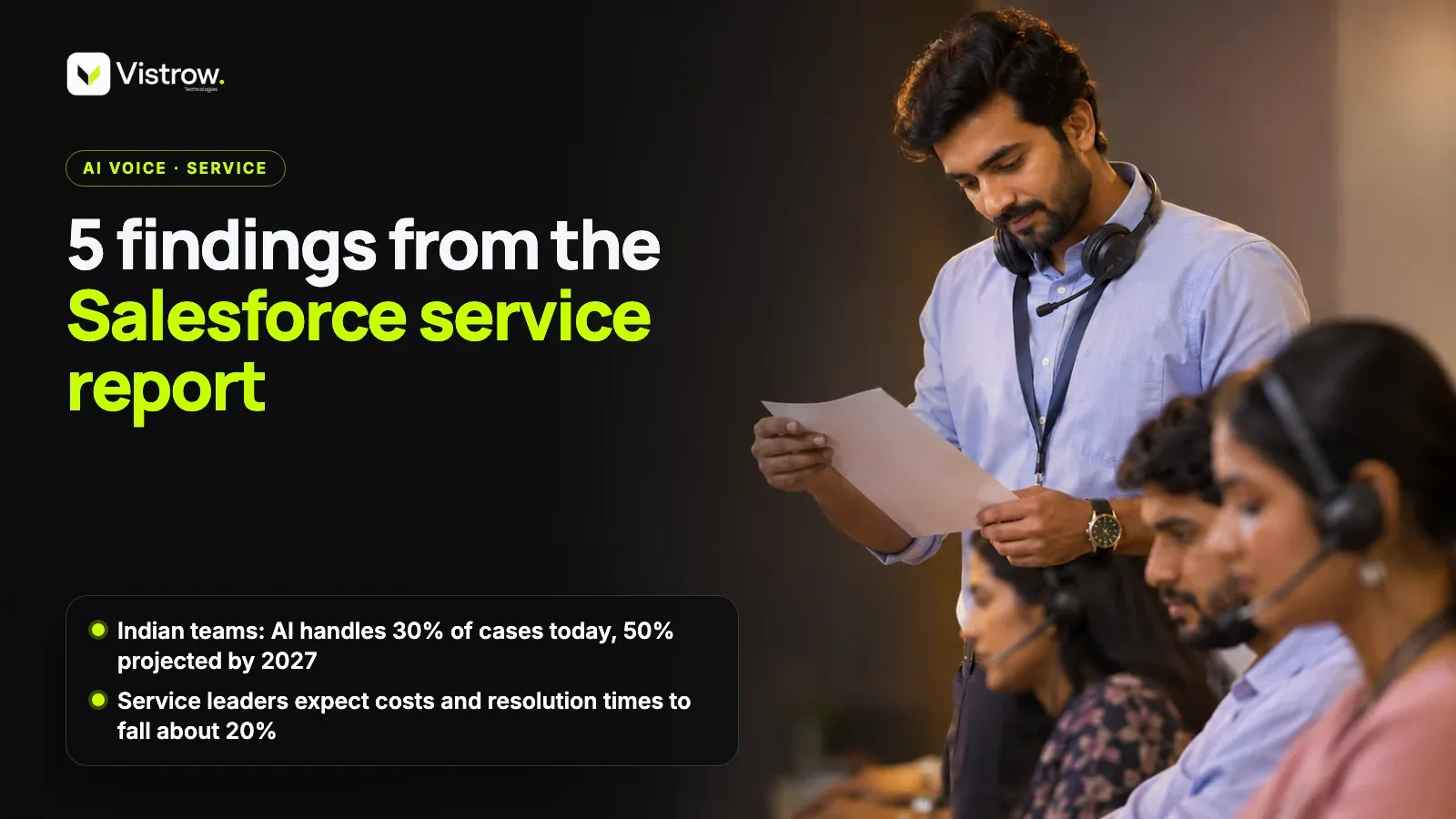
- Finding 1: AI is taking a larger share of cases, with 30% today and 50% projected by 2027.
- Finding 2: leaders using AI agents expect costs and resolution times to fall by an average of 20%.
- Finding 3: reps spend only 46% of their time with customers, so admin is the first thing to automate.
- Finding 4: voice AI is accepted when the transfer to a person works well.
- Finding 5: data silos and security, not the AI itself, are what slow most projects down.
| Finding | Global | India |
|---|---|---|
| Cases handled by AI today | 30% (2025) | 30% (team estimate) |
| Cases expected to be handled by AI by 2027 | 50% | 50% |
| Leaders who say AI agent investment is essential | 79% | Not reported |
| Voice AI users who say handoffs to humans are smooth | 85% | 90% |
| Main blocker reported | 44%: tech silos | About half: security |
What do the India findings add?
Reported coverage of Salesforce's India research says AI jumped from seventh to second on Indian service leaders' priority lists in one year, while improving customer experience stayed first. Indian teams estimate that 30% of cases are already handled by AI and project 50% by 2027. Indian service professionals also project that agentic AI will raise upsell revenue by 16%. You can read the India summary for the full list.
Two more India figures matter for planning. 44% of Indian service teams already use multimodal AI, which handles text, voice and images together. And half of Indian service leaders say security concerns have delayed or limited their AI initiatives. For a smaller business, that second point is a reminder to choose tools that keep customer data in your own CRM and show you every conversation.
What the report says about service staff
A lot of coverage of AI in service focuses on replacing people. The State of Service report points in a different direction. 83% of service reps at organisations with AI say they have better career prospects because of it, and 82% say working with AI has helped them build new skills. 65% of teams with AI report more chances to focus on customer relationships, and 54% report more time to improve processes.
That matches the time finding earlier in the report. If reps spend only 46% of their time with customers, the first gain from AI is giving back hours lost to notes, data entry and looking things up. For a small team, this often matters more than case deflection. A rep who no longer types call summaries by hand can return more calls the same day.
Field service shows the same pattern. Mobile workers estimate that 18% of their working hours, more than seven hours in a standard week, go on admin such as forms and searching for information, and 37% of technicians say admin keeps them from doing their actual job.
What should a growing business do with these findings?
Survey averages are not targets. A 40-person service desk in Bengaluru and a five-person sales team in Pune have very different problems. Use the findings to choose where to start, then measure against your own numbers.
Start with the questions your team answers most often: prices, timings, location, document lists, booking changes. Those are the cases an AI agent can take first. Keep complaints, refunds and anything needing judgment with people. Then fix the handoff so a customer never repeats themselves after being transferred.
Write down your baseline before any change goes live: average first response time, share of calls missed, and how many enquiries get a follow-up within a day. Without those three numbers you cannot tell whether the AI helped, and you will be left comparing yourself with survey averages that were never about your business.
- 1
List your top 20 repeated questions
Pull them from WhatsApp chats, call notes and email for one month.
- 2
Pick one channel to automate first
Usually WhatsApp or phone, whichever brings the most repeated questions.
- 3
Write the answers from your own documents
The AI should answer from your price lists, policies and brochures, not guess.
- 4
Design the human handoff
Set clear rules for when the AI passes to a person, and pass the full conversation with it.
- 5
Connect it to your CRM
Every conversation, outcome and transcript should land on the customer record.
- 6
Measure for 30 days
Compare first response time, resolution time and calls missed before and after.
Where voice AI fits for Indian service teams
The report's voice findings are the most practical for Indian businesses, because so much service still happens on the phone. The 90% India figure on smooth handoffs comes from teams already using voice AI, and it shows that customers accept an AI voice when they can reach a person easily.
Language is the other factor. Many Indian callers switch between Hindi, English and a regional language mid-sentence. Vistrow Voice is India-native voice AI for inbound, outbound and web calls in 130+ languages, including Hindi, English and 9 more Indian languages, with mid-sentence language switching, answers grounded in your uploaded documents, controlled escalation and human handoff, and CRM webhooks that push leads, outcomes and transcripts. Its price is not public; you can see how it works on the AI voice calling page.
Before launch, test the agent the way a customer would, including awkward questions and requests for a person. The checklist in why reliability is key for AI voice agents covers what to test, and the AI voice calling agents guide covers how contact centres plan a rollout.
Common mistakes when adding AI to customer service
The report's blockers, data silos and security, show up in small businesses too, just on a smaller scale. A few mistakes are worth avoiding from the start.
- Letting the AI answer from general knowledge instead of your own price lists and policies
- Hiding the option to reach a person, which turns a quick query into a complaint
- Keeping AI conversations in a separate tool that your team never checks
- Launching on every channel at once instead of proving one first
- Measuring only how many chats the AI closed, not whether customers got the right answer
What the report does not tell you
It does not tell you what your own savings will be. The 20% cost and resolution figure is an expectation from leaders already using AI agents, averaged across very different companies. It also does not break results down by business size, and most of the full report sits behind a form.
So treat the Salesforce State of Service report as a map of where service is heading, not a promise. Measure your own baseline first, change one channel at a time, and keep the numbers that show whether the change helped. If you want a second opinion on where to start, a free growth audit looks at your enquiry channels and follow-up together.
Frequently asked questions
What is the Salesforce State of Service report?
It is a survey-based report Salesforce publishes on customer service teams. The seventh edition, released in 2025, surveyed service professionals worldwide, including India, on customer expectations, AI use, AI agents, voice AI and field service. Salesforce publishes a summary on its site and gives the full report behind a form.
What does the State of Service report say about India?
Indian service teams estimate that 30% of cases are handled by AI today and project 50% by 2027. AI rose from seventh to second on Indian service leaders' priority lists in a year, 44% of Indian teams use multimodal AI, and half say security has delayed or limited their AI plans.
Will AI replace customer service staff?
The report does not say that. It describes AI agents working alongside people, and 83% of reps at organisations with AI say their career prospects are better because of it. In practice AI takes repetitive questions and admin, while people handle judgment, complaints and relationships.
How can a small business use these findings?
Start with the repeated questions your team answers every day, move those to an AI agent or automated replies, and make the handoff to a person easy. Connect it to your CRM so every conversation is saved. Measure response time and resolution before and after rather than relying on survey averages.
Are the State of Service figures guaranteed results?
No. They are survey answers and expectations from service professionals, not measured outcomes for your business. For example, the 20% figure is what leaders using AI agents expect to save, on average. Treat them as a sense of direction and test against your own numbers.
Comments