
Live agents run about $200 to $600 a month, basic AI plans start near $30. Compare five after-hours options, a worked cost example and the vendor questions that matter.
Search and explore the blog
Explore the blog
Category
Suggested reading
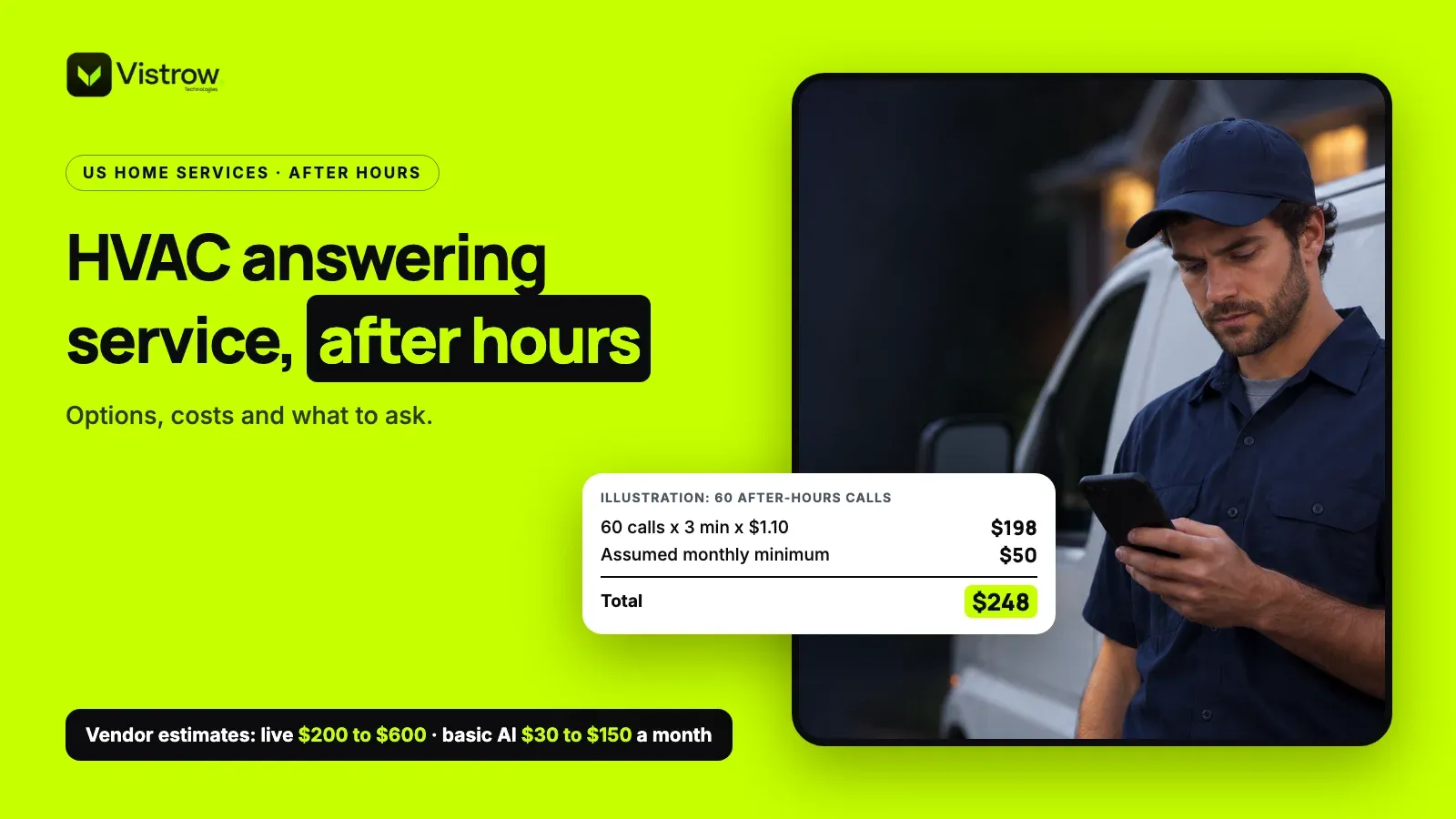
A hvac answering service for after-hours calls typically costs about $200 to $600 a month with live agents, or roughly $30 to $150 for a basic AI plan, according to vendor estimates. One captured emergency job worth $500 to $1,000 or more often covers a full month. The harder question is which option fits your call volume and your dispatch process.
A common mistake is judging the service by its monthly price and ignoring what happens to the 2 a.m. no-heat call. If it lands in voicemail, the caller may well dial the next contractor on the search results before you wake up. The fee you saved on the answering side comes out of the job you never saw.
This guide compares five ways to cover after-hours calls, works through a cost example you can reuse, and lists the questions that separate a useful vendor from an expensive message taker.
What is an HVAC answering service?
An HVAC answering service is a team or software that picks up your phone when your office is closed or busy, collects the caller's details, judges how urgent the problem is, and passes the job to you. Some are staffed by live human agents, some run on AI voice, and some combine the two.
The good ones do more than take a message. They ask triage questions (no heat, no cooling, water leak, gas smell), tell the caller what happens next, and send your on-call technician a text with the address, the problem and a callback number. The weak ones read a script and email you a transcript at 7 a.m.
If you search for an answering service for contractors, you will see general services that cover plumbers, electricians and roofers too. That can work, but check that the agents know the difference between a tune-up request and a furnace that is down in a freeze.
How much does an after-hours answering service cost?
Treat every number in this section as a vendor estimate, not an independent benchmark, and not a current quote. Live human services are commonly quoted at about $200 to $600 per month for a mid-size contractor. Per-minute rates show up around $0.75 to $2.00, and some vendors charge per call instead, with figures in the $2.50 to $7.00 range.
AI answering services are advertised from about $30 to $150 per month for basic plans. The low end usually means limited call minutes, fewer integrations and no human fallback. Read what the basic tier leaves out before you compare it to a live service.
The pricing structure matters as much as the headline. Per-call and per-minute plans can spike when the weather turns. One vendor source describes a bill of $400 in April against $1,200 in July for the same account. That is exactly when your phones ring most, so a flat-looking quote can hide a bill three times larger in a heat wave or a cold snap.
The break-even logic is simple. One emergency job worth $500 to $1,000 or more often pays for a month of service. If a service captures even one call a month that would otherwise have gone to a competitor, the maths works. If it captures none, because it only takes messages you then fumble, no price is cheap.
What does a worked monthly cost look like?
Here is a simple illustration, not a quote. Say your business gets 60 after-hours calls a month, each lasting about 3 minutes, on a per-minute plan at $1.10 per minute. That is 60 x 3 = 180 minutes, and 180 x $1.10 = $198. Add an assumed $50 monthly minimum and you land at $248.
Now stress it. If a heat wave doubles your calls to 120, the same maths gives 360 minutes and $396 before the minimum or any overage fees. Longer calls push it higher again, because agents who chat with a worried homeowner for 6 minutes cost twice as much as ones who triage in 3.
This is why a hvac answering service quoted per minute needs a cap or a clear overage rule. Ask for the bill from the vendor's busiest month, not their average one.
| Line | Assumption | Amount |
|---|---|---|
| After-hours calls | 60 per month | 60 calls |
| Average length | 3 minutes | 180 minutes |
| Usage cost | 180 x $1.10 | $198 |
| Monthly minimum | Assumed | $50 |
| Total | Usage plus minimum | $248 |
What to ask any vendor before you sign
Most vendor demos are polished, so the questions you ask decide what you learn. Ask for answers in writing, and ask for a trial period or a short contract if you are unsure.
Pricing questions come first because that is where surprises hide. After that, test the handoff, because a message that reaches you ten minutes late is worth little in an emergency.
- Do you charge per minute or per call, and how is a partial minute rounded?
- What are the overage fees once I pass my plan's included minutes or calls?
- Does the price change in peak seasons, heat waves or cold snaps?
- How do after-hours transfers work, and who exactly gets the emergency call?
- Will you text me a job summary with address, problem and callback number?
- Can you book into my software, and can you show it live in my account?
- How do you disclose call recording, and can I see the script?
- How long is the contract, and what does cancelling cost?
Call recording consent: what to check before you record
US states differ on recording calls. Some follow one-party consent, where one person on the call agreeing is enough. Others require all-party consent, where everyone must agree. Your caller may be in a different state from your office, so the safe habit is to tell every caller at the start that the call may be recorded.
Do not assume the vendor has this covered. Ask what the greeting says, whether it plays before any conversation starts, and who stores the recordings and for how long. The Reporters Committee recording guide summarises one-party and all-party rules by state. Then check your own state's rules, ideally with a lawyer, because this article is not legal advice.
Recordings are useful. They let you hear how a triage call went and settle disputes about what a customer asked for. They are only useful if you are allowed to keep them.
How to test an after-hours setup before you commit
Run your own mystery calls. Ring the service at night, on a weekend and during a busy period if you can, and play a realistic emergency. Then check how fast the text summary reaches your on-call phone and whether the details are right.
- 1
Write your triage script
List the questions for no heat, no cooling, leaks and gas smell, and decide which ones are true emergencies.
- 2
Set the escalation rule
Name who gets the call, in what order, and what happens if nobody answers.
- 3
Make three test calls
Call at night, on a weekend and with an awkward caller, then compare the summaries.
- 4
Check the booking
Confirm that a job appears correctly in your software, not just in an email.
- 5
Review the first month's bill
Compare minutes used against the quote and look for overage or seasonal charges.
Where Vistrow fits, and what a quote needs
Vistrow is an AI-powered digital marketing and automation agency based in Pune, with a page for US home services businesses. This post is about choosing well, not about choosing Vistrow.
If you want an AI layer, Vistrow Voice can answer, qualify and route a call, with escalation rules for when to hand off to a person and call transcripts you can review. Read more about AI voice calling if you are weighing that route.
Quotes are written after a free audit of your call volume, your software and your escalation needs, so the price reflects how you actually run nights and weekends.
Frequently asked questions
How much does an HVAC answering service cost?
Vendor estimates put live human services at about $200 to $600 per month for a mid-size contractor, with per-minute rates around $0.75 to $2.00. AI plans are advertised from roughly $30 to $150 per month for basic tiers. These are vendor figures, not independent ones, so get a current quote.
Is an AI receptionist better than a live answering service for HVAC?
Neither wins outright. Live agents handle upset callers and odd situations well, while AI is cheaper and answers instantly at any hour. Many contractors choose a hybrid: AI answers and triages, and a person or on-call technician takes true emergencies. Test both on your own call mix.
What should an after-hours HVAC answering service do on an emergency call?
It should confirm the caller's name, address and callback number, ask triage questions such as no heat, no cooling or gas smell, and hand off to your on-call technician. It should also text you a job summary. A gas smell should be told to leave the home and call emergency services.
Can an answering service book jobs into ServiceTitan or Housecall Pro?
Some can, but it varies by vendor and plan. Ask whether the booking is a real integration or just an emailed message you re-enter by hand. Request a live demo that creates a job in your own software account before you sign anything.
Do I need consent to record after-hours calls in the US?
It depends on the state. Some states need only one party's consent, while others require all parties to agree. Because callers may be in a different state than you, play a clear recording disclosure at the start of every call and check your state's law with a lawyer.
Comments