
A clever demo is easy. A voice agent that answers correctly, quickly and safely on every live call is harder. Here is what to test before launch and what to watch after it.
Search and explore the blog
Explore the blog
Category
AI voice agent reliability means the agent gives a correct answer, at a natural speed, on every call, and hands the caller to a person when it should. A good demo shows intelligence. Reliability decides whether you can let the agent take real customer calls at 9 pm on a Sunday. Test answers, speed, languages, handoffs and data before launch.
This guide explains what each part of reliability means, gives you a scorecard to run before launch, and shows how to keep the agent dependable once it is live. It is written for Indian businesses that take calls in Hindi, English and regional languages, where real calls are far messier than any demo script.
What does AI voice agent reliability actually mean?
Reliability is a set of promises you make to every caller. If any one of them breaks on a live call, the caller remembers that call, not the hundred that went well. Break it into five parts and test each one separately.
- Correct answers: the agent answers from your own price lists, policies and brochures, and says so when something is not covered.
- Speed: the gap between the caller finishing a sentence and the agent replying feels like a normal conversation.
- Language handling: the agent copes with Hinglish, accents, background noise and callers who switch language mid-sentence.
- Safe failure: when the agent is unsure, or the caller is upset, it hands over to a person instead of improvising.
- Complete data: every call leaves a record in your CRM with the outcome, the answers given and a transcript.
Why is a reliable agent worth more than a clever one?
A demo runs on clean audio, a quiet room and questions the vendor expects. A live call runs on a mobile network, with traffic in the background and a caller who asks two things at once. An agent that sounds brilliant in a demo and invents an answer on a live call does more damage than an agent that was never switched on.
The cost of one wrong answer is uneven. If the agent quotes the wrong price, promises a discount you do not offer or books a slot that does not exist, a person on your team has to undo it, and the customer now doubts every future call. That is why the right question for any vendor is how the agent behaves when it does not know, not how much it knows.
There is also a scale effect. A human telecaller who gives a wrong answer does it on one call. An agent with a wrong line in its documents repeats the same mistake on every call that asks that question, until someone notices. That is the strongest argument for treating AI voice agent reliability as an ongoing job with an owner, rather than a box ticked at launch.
Reliability also decides how much work the agent really takes off your team. If staff have to listen to every recording to check for mistakes, you have added a review job instead of removing a calling job.
How fast should an AI voice agent respond?
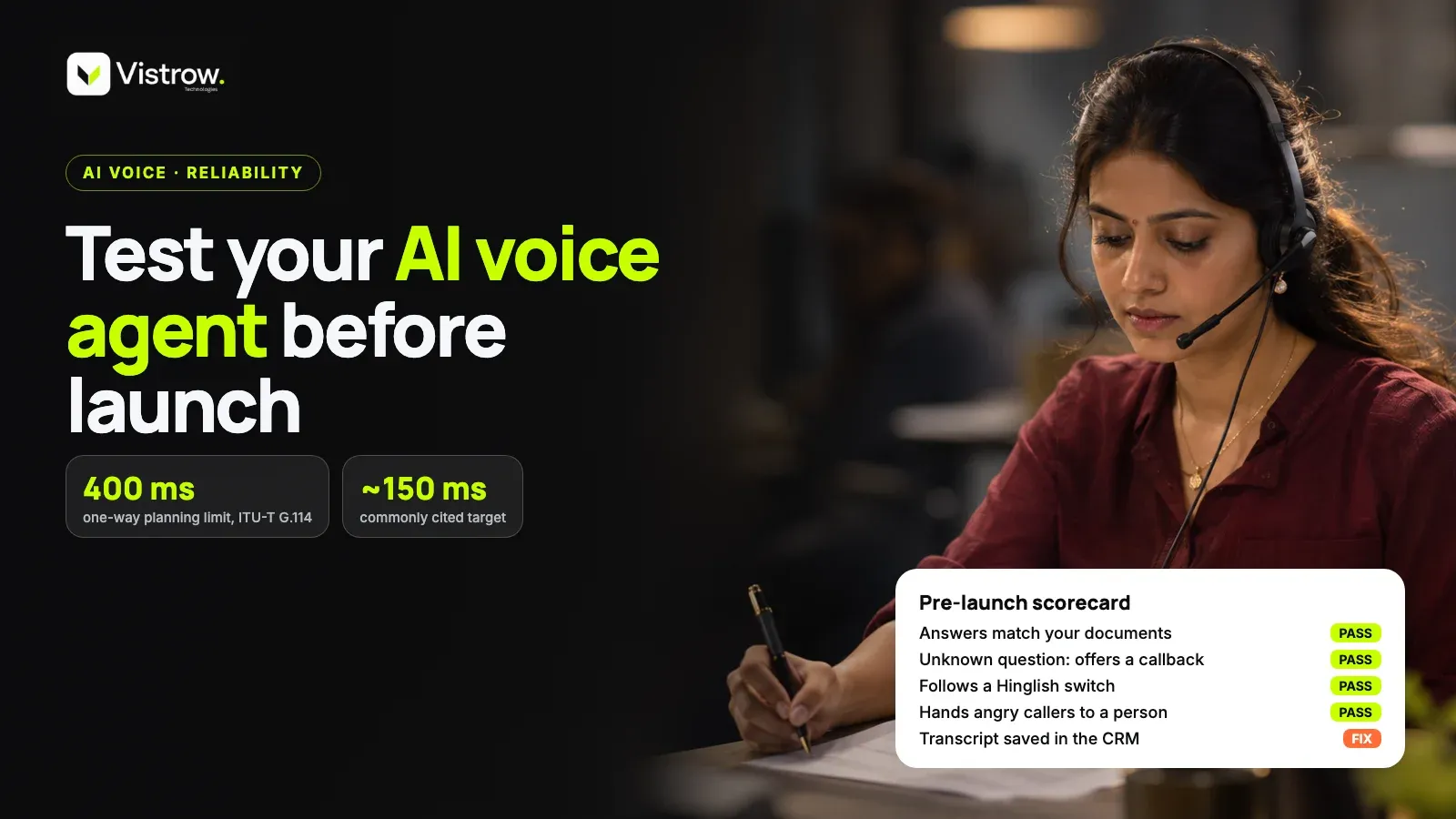
Long silences make callers repeat themselves, talk over the agent or hang up. The international standard for voice delay, ITU-T Recommendation G.114, sets 400 ms of one-way delay as the limit for general network planning and notes that highly interactive tasks, such as many voice calls, are affected by less delay than that. A figure of about 150 ms one-way is the commonly cited target for good conversational quality.
An AI agent adds its own thinking time on top of the network. So measure what the caller actually hears: the gap between the end of their sentence and the start of the reply. Measure it on ordinary 4G and 5G connections, not on office Wi-Fi, and at your busiest hour, not at 7 am.
Also test interruptions. Real callers cut in with "haan, haan" or a new question while the agent is still talking. A reliable agent stops, listens and answers the new question instead of finishing its script.
A reliability scorecard to run before launch
Use this scorecard with your own test calls. Mark each row pass or fail, and do not launch while any row in the first five fails.
| Area | What to test | Pass looks like | Fail signal |
|---|---|---|---|
| Answers | Questions from real past calls | Answer matches your documents | Invented prices, offers or dates |
| Unknown questions | Topics not in your documents | Says it will arrange a callback | Guesses or changes the subject |
| Speed | Reply gap on mobile networks | Feels like a normal phone call | Long silences, callers repeat themselves |
| Languages | Hindi, English, Hinglish and your regional languages | Follows a mid-sentence switch | Replies in the wrong language |
| Handoff | Angry caller, complaint, request for a person | Transfers or books a human callback | Keeps the caller in a loop |
| Interruptions | Caller cuts in mid-reply | Stops and answers the new point | Talks over the caller |
| CRM data | Lead record after each test call | Outcome, answers and transcript saved | Missing fields or no record |
How to test an AI voice agent before launch
Testing does not need a lab. It needs real questions, real phones and a few people willing to be difficult callers for an afternoon.
- 1
Collect real questions
Pull questions from past call recordings, WhatsApp chats and enquiry forms, not from a vendor script.
- 2
Load your documents
Give the agent your current price list, policies and FAQs, and remove anything outdated.
- 3
Call in every language
Run the same questions in each language you serve, including mixed Hinglish sentences.
- 4
Try to break it
Ask off-topic questions, interrupt, go silent, ask for a manager and give unclear answers.
- 5
Check every record
Open the CRM after each call and confirm the outcome, answers and transcript are there.
- 6
Fix and repeat
Update documents or settings for every failure, then rerun the failed calls.
What should happen when the agent does not know the answer?
The safest behaviour is simple: the agent says it does not have that detail, offers a callback from a person, and logs the question. It should never fill the gap with a likely sounding answer. This is what knowledge-grounded answering means in practice: the agent speaks only from documents you have uploaded and approved.
It also helps to tell callers up front that they are speaking with an AI assistant and that a person is available. Callers are more patient with an agent that is honest about what it is, and they ask for a person sooner when they need one, which is exactly what you want.
Decide in advance which topics always go to a person. Complaints, refunds, legal questions and anything involving money already paid are common choices. Write these rules down and test each one, because a handoff rule that exists only in a settings screen is easy to get wrong.
Vistrow Voice is built around these controls: answers grounded in your uploaded documents, controlled escalation and human handoff, mid-sentence language switching across 130+ languages, including Hindi, English and 9 more Indian languages, and CRM webhooks that push leads, outcomes and transcripts to your system. For where AI should stop and a person should take over, see what AI calls should handle and when a human takes over.
Which rules affect AI voice calling in India?
A reliable agent also has to be a compliant one. Calling hours, consent and the difference between promotional and service calls all apply to AI calls just as they do to human telecallers. Our guide on whether cold calling is illegal in India covers TRAI, DND and DPDP rules in detail.
For managing AI risk more broadly, the US NIST AI Risk Management Framework is a voluntary framework many teams use as a checklist. Its core idea fits voice agents well: decide who is accountable, measure how the system behaves, and review it on a schedule instead of once at launch.
How do you keep an AI voice agent reliable after launch?
Reliability drifts. Prices change, a new project launches, a policy is updated, and the agent keeps answering from last month's documents unless someone updates them. Put one person in charge of the agent the way you would put someone in charge of a sales team.
Treat the agent's documents like a price list on a showroom wall: if it is out of date, every visitor sees the wrong number. Review them whenever your offer changes, and date each document so you know which version the agent used on any call. Good AI voice agent reliability after launch comes from these small habits more than from any single setting.
If you are weighing an AI agent against hiring, our comparison of AI telecaller cost per call vs a human telecaller shows how to compare the two fairly. To see how AI calling fits into a full lead workflow, visit AI voice calling.
- Review a sample of transcripts every week, including calls that ended in a handoff.
- Keep a list of questions the agent could not answer and turn them into document updates.
- Watch the handoff rate: a sudden rise usually means something changed in your offer or documents.
- Check call outcomes in the CRM against what your team sees in follow-up calls.
- Retest the scorecard every time you change prices, scripts or languages.
Frequently asked questions
What is AI voice agent reliability?
AI voice agent reliability is how consistently an agent gives correct answers, replies at a natural speed, handles your callers' languages, hands over to a person when needed and saves complete call data. It is measured on live calls over weeks, not in a single demo, and it decides whether customers trust the calls.
How do I test an AI voice agent before launch?
Use real questions from past calls and chats, call in every language you serve, and test on ordinary mobile networks. Try to break it with interruptions, off-topic questions and requests for a manager. After each call, check the CRM record. Fix every failure and repeat the failed calls before launch.
What should an AI voice agent do when it does not know an answer?
It should say it does not have that detail, offer a callback from a person and log the question. It should never guess. Answers should come only from documents you uploaded and approved, and topics such as complaints or refunds should always go to a human.
How fast should an AI voice agent reply?
Fast enough to feel like a normal phone call. ITU-T G.114 sets 400 ms one-way delay as the limit for general network planning, and about 150 ms is the commonly cited target for good conversation. Measure the gap callers actually hear, on mobile networks, at your busiest hour.
How often should I review an AI voice agent after launch?
Review a sample of transcripts every week, and retest the full scorecard whenever prices, scripts, documents or languages change. Keep a list of unanswered questions and turn them into document updates, and watch for sudden changes in the handoff rate, which usually signal outdated information.
Comments