
Agentic AI plans steps and uses tools to finish a goal. It works on narrow, repeatable jobs with clear rules and fails on vague ones. Here is how to choose a first project.
Search and explore the blog
Explore the blog
Category
Suggested reading
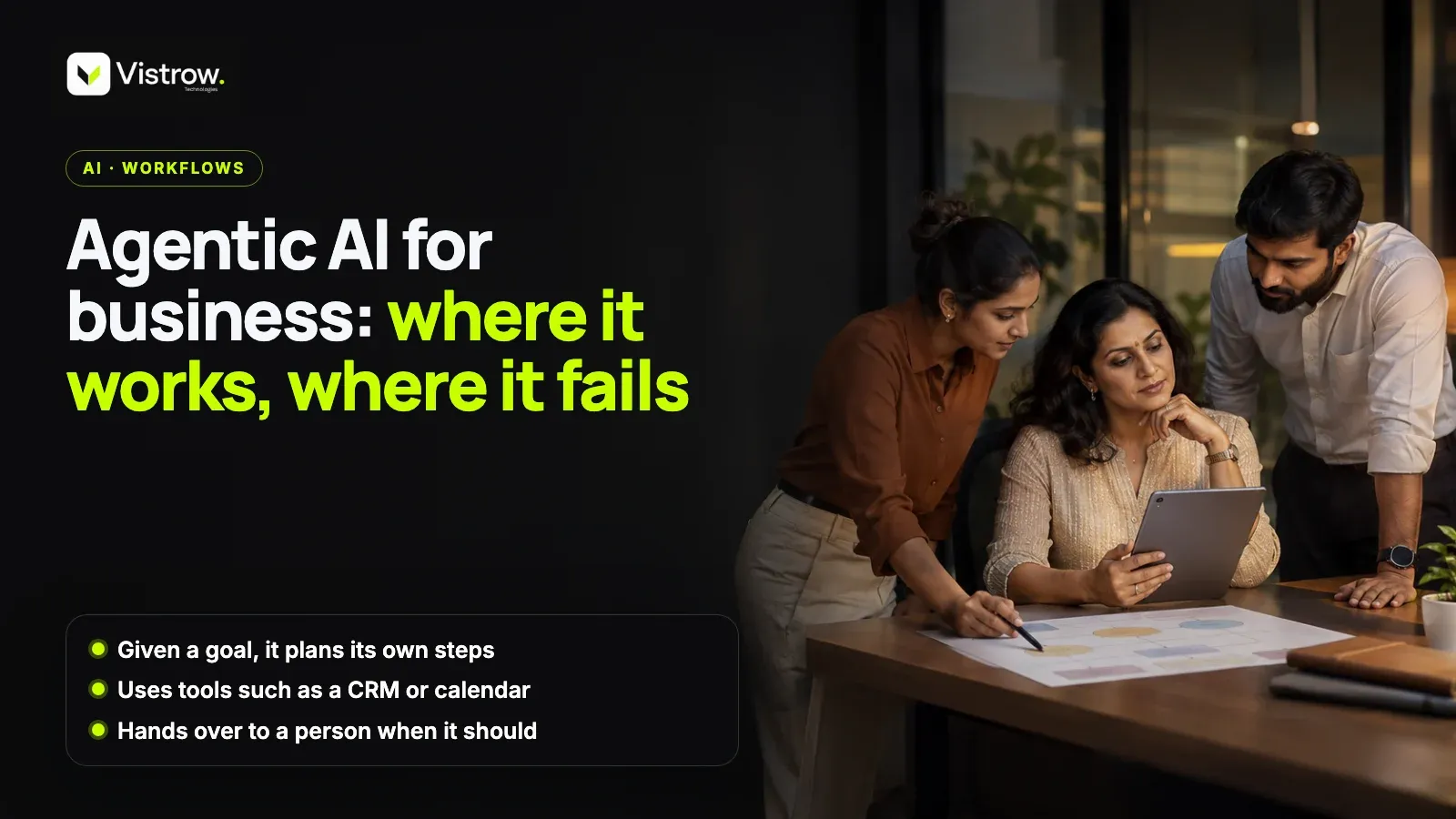
Agentic AI is a type of software that is given a goal, plans the steps, uses tools such as a CRM, calendar or phone line, and checks its progress until the job is done or it hands over to a person. For a business, agentic AI is useful on narrow, repeatable jobs with clear rules, and risky on open-ended ones.
This guide explains the difference between chatbots, automation and agents, where agentic AI is working in real business workflows today, why so many projects get cancelled, and how to pick a first project that pays back.
What is agentic AI, in plain terms?
Most business software follows a script. Agentic AI follows a goal. You tell it what outcome you want and what it may and may not do, and it works out the steps.
Anthropic, which builds the Claude models, draws a useful line in its guide to building effective agents. Workflows are systems where models and tools run through predefined code paths. Agents are systems where the model directs its own process and tool use. The same guide advises starting with the simplest solution that works and adding agent behaviour only when the task needs it. IBM's explainer on agentic AI describes the same idea: a system that can act on its own toward a goal with limited supervision. Google Cloud also publishes a guide on what agentic AI is and how it differs from other AI.
The table below shows where the lines fall.
| Type | Who decides the steps | Business example | Best for |
|---|---|---|---|
| Rule-based automation | You, in advance | Form submitted, send a WhatsApp template | Simple, predictable tasks |
| Chatbot | The script or the model, one reply at a time | Answering a pricing FAQ on the website | Questions with known answers |
| AI workflow | Code fixes the order, the model fills each step | Summarise each call and save it to the CRM | Repeatable multi-step jobs |
| Agentic AI | The model, within limits you set | Qualify a lead, offer a slot, book it, hand over | Messy inputs with a clear goal |
How is agentic AI different from automation you already have?
Rule-based automation breaks when the input is unexpected. If a buyer replies "next month maybe, what about parking?" to a template, a rule cannot handle it. An agent can read the reply, answer the parking question from your documents, note the timeline and decide whether to offer a visit now or follow up later.
That flexibility has a cost. An agent can choose a wrong step, so it needs boundaries: which tools it may use, what it must never promise, and when it must stop and call a person. Good agentic AI setups are mostly about those boundaries, not about the model.
For many jobs a plain workflow is still the better choice. Our list of marketing automation workflows covers the ones that need no agent at all.
Where does agentic AI work in real business workflows today?
The jobs that work share three traits: high volume, clear rules, and a clean handoff to a person. Four examples are already practical for Indian businesses.
- Lead qualification on WhatsApp. The ArthaLeads WhatsApp AI agent, on the Growth and Enterprise plans, asks a buyer about needs, budget and timeline, shares the brochure and location, books site visits and saves the answers on the lead. The team can take over any chat.
- Inbound and outbound calls. Vistrow Voice answers from uploaded documents, works in 130+ languages, including Hindi, English and 9 more Indian languages, pushes leads, outcomes and transcripts to the CRM through webhooks, and escalates to a person when needed.
- Support triage. An agent reads a ticket or message, finds the order or account, answers routine questions and routes the rest to the right person with a summary.
- Scheduling. An agent offers slots, books them in a calendar, sends reminders and reschedules when a customer asks.
Which of these jobs is hardest to get right?
Voice is the most demanding of these, because a caller expects a fast, natural answer. For the details on voice specifically, read our guide to AI voice calling agents.
What does an agentic AI conversation look like in practice?
Take a property enquiry that arrives on WhatsApp at 11 pm on a Sunday. A rule-based setup sends a fixed template and waits for Monday. An agent reads the message, sees that the buyer asked about two-bedroom flats and parking, answers both from the project brochure, and asks the questions a good salesperson would ask next: budget, timeline and whether the buyer is looking for a home to live in or an investment.
If the buyer gives a clear budget and wants to visit, the agent offers available site-visit slots, books one and saves every answer on the lead in the CRM. If the buyer asks about a discount, the agent does not invent one. It says a sales manager will call with pricing and flags the lead for the morning. If the buyer writes something angry or confusing, it stops and hands the chat to a person.
On Monday morning the sales team does not start from a blank lead. They see what the buyer asked, what the agent answered, what was booked and what still needs a human. The agent did the routine part of the conversation. The people do the part that needs judgement.
That is the pattern to look for in any agentic AI project: the agent handles the steps with clear answers and clear rules, and hands over at the points where a wrong answer would cost money or trust.
Why do so many agentic AI projects fail?
In June 2025 Gartner predicted that over 40% of agentic AI projects will be cancelled by the end of 2027, because of rising costs, unclear business value or weak risk controls. Gartner also warned about "agent washing", where existing chatbots and automation tools are rebranded as agents, and estimated that only about 130 of the thousands of vendors claiming agentic AI offer the real thing.
Those reasons map to mistakes you can avoid:
- Starting with the technology instead of a job. "We need an AI agent" is not a project. "Reply to every new enquiry within minutes, including at night" is.
- No measure of value. If you cannot say what number should change, such as response time or booked visits, you cannot tell if it worked.
- No boundaries. The agent is never told what it must not say or promise, so one bad answer becomes a complaint.
- No testing on real conversations before launch, which is where accents, slang and half-answers show up. Our post on AI voice agent reliability covers pre-launch testing.
How do you pick your first agentic AI project?
Choose one job, prove it, then expand. This sequence keeps cost and risk small.
- 1
Pick a narrow, high-volume job
After-hours enquiry replies, lead qualification or appointment booking are good starting points.
- 2
Write the rules and limits
What the agent may do, which tools it may use, what it must never promise, and when it must hand over.
- 3
Ground it in your documents
Brochures, price lists, FAQs and policies, so answers come from your facts and not from guesswork.
- 4
Connect it to your systems
The CRM, calendar or helpdesk, so every conversation leaves a record a person can pick up.
- 5
Test with real conversations
Use past enquiries, mixed languages and awkward questions before any customer hears it.
- 6
Measure one number
Response time, booked visits or resolved tickets. Review weekly and expand only when it moves.
How do you keep an AI agent safe and accountable?
An agent that can act on your systems needs the same controls you would give a new employee, written down before launch rather than after the first mistake. Treat it as a junior team member with a narrow role, a clear manager and a record of everything it does.
Give it only the access it needs. An agent that books site visits needs the calendar and the lead record, not your accounts system. Keep a full log of every conversation and every action, so a person can check what happened and why. Review a sample of conversations every week in the first months, and fix the instructions or documents whenever an answer is wrong.
Be open with customers. Tell people they are talking to an AI agent, make it easy to reach a person, and handle personal data the way your privacy policy says you do. Collect only what the job needs, and keep consent records for any follow-up messages or calls. If you work in a regulated area such as lending, insurance or healthcare, check the sector rules with your compliance adviser before an agent speaks to customers.
Finally, decide in advance who owns the agent inside the business. Someone has to read the weekly review, approve changes to its instructions and switch it off if something goes wrong. Projects without an owner drift, and drifting projects are the ones that end up on the cancelled list.
What should stay with people?
Agentic AI handles the first conversation and the routine steps well. Some decisions should stay with a person, whatever the vendor says: price negotiation and discounts, complaints and angry customers, legal or contractual commitments, refunds, and anything that cannot be undone. A good agent knows these limits and hands over with a summary, so the customer never has to repeat themselves.
If you want help choosing and building a first agentic AI project around your own process, see our custom automation and AI voice calling services.
Frequently asked questions
What is agentic AI in simple words?
Agentic AI is software that is given a goal rather than a fixed script. It decides the steps, uses tools such as a CRM, calendar or phone line, checks the result and either finishes the job or hands it to a person. A chatbot answers a question; an agent can also act on the answer.
How is agentic AI different from normal automation?
Normal automation follows rules you wrote in advance: if a form is submitted, send this message. Agentic AI decides what to do next based on the situation, within limits you set. That makes it more flexible on messy inputs such as free-text questions, and also less predictable, which is why it needs testing and clear boundaries.
Is agentic AI ready for small businesses?
Yes, for narrow jobs. Answering new enquiries on WhatsApp, qualifying leads on a call, booking appointments and routing support questions are already practical. Open-ended jobs such as running your whole marketing or making pricing decisions are not. Start with one job that has high volume, clear rules and a clear handoff to a person.
Why do agentic AI projects fail?
Gartner named three reasons in its June 2025 prediction: rising costs, unclear business value and weak risk controls. In practice, many projects start with the technology instead of a specific job, skip testing on real conversations and never define when the agent must hand over to a person. Fixing those three points prevents most failures.
Is an AI voice agent an example of agentic AI?
Yes, when it does more than read a script. A voice agent that answers from your documents, asks qualifying questions, books a slot, writes the outcome to your CRM and transfers to a person when needed is acting as an agent. Vistrow Voice works this way, with controlled escalation and human handoff.
Comments